
Makerspaces unite theory and practice in KTH’s programmes
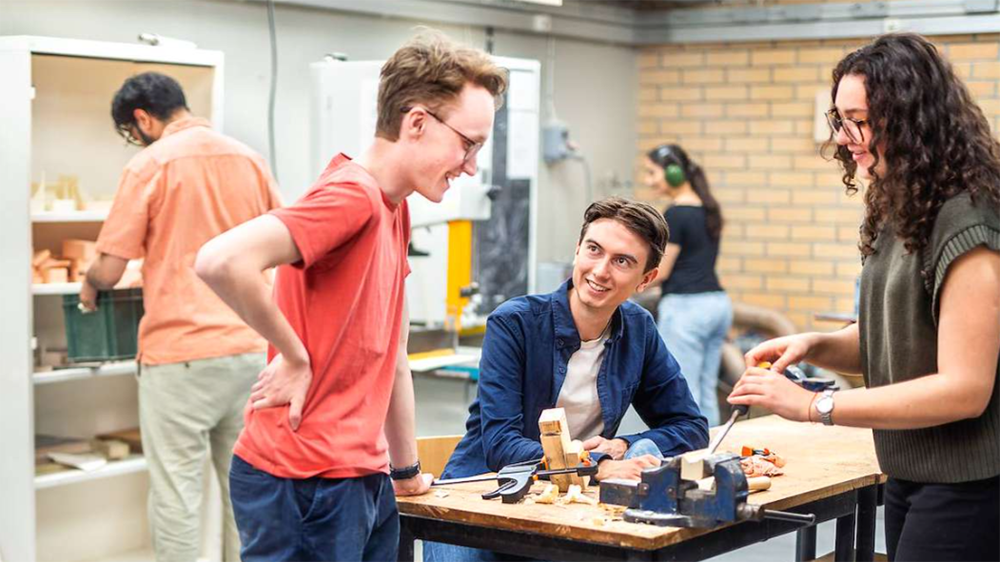
KTH is now building a network of makerspace environments designed to give all students the opportunity to build, prototype and solve real-world problems throughout their studies. President Anders Söderholm believes that this is a vital step towards a more forward-looking approach to engineering education

Over time, engineering degree programmes have become increasingly theoretical. KTH aims to reverse this trend and decided last year that every school should have a dedicated makerspace . The links between theory and practice in KTH’s degree programmes will be strengthened by establishing accessible and inclusive makerspaces alongside lecture theatres and specialist laboratories.
“Engineering degree programmes have become increasingly theoretical, while the AI revolution is simultaneously driving the need for change in our programmes. We are therefore creating makerspaces for our students, where we can prepare them for working life even better by ensuring that theory and practice go hand in hand. This will also develop a learning environment that equips them with the necessary skills for their future careers,” says Anders Söderholm, President of KTH.
We are therefore creating maker spaces for our students, where we can prepare them for working life even better by ensuring that theory and practice go hand in hand. This will also develop a learning environment that equips them with the necessary skills for their future careers.
The initiative takes the form of a network comprising specialised maker environments at each of KTH’s five schools, as well as a central makerspace. The new KTH Central Makerspace is set to open in the refurbished KTH Library in 2027, coinciding with KTH’s 200th anniversary. These spaces will be integrated into degree programmes and will be open to all students and staff. They will be inclusive, accessible and easy for beginners to get started with, even those who have never built a prototype before.
Until now, opportunities to build and experiment have largely been reserved for more advanced students. However, the makerspaces are now open to all students right from the start of their studies. Rather than waiting until their final years, students are given the chance to engage in practical, project-based work throughout their degree. Joakim Lilliesköld, deputy programme manager for “ Future Education ”, believes this is a valuable addition.
“Practical engineering training is a missing piece of the jigsaw in several of our programmes and is needed for a number of reasons in future courses,” says Joakim.
According to Joakim, these learning environments also open the possibility of turning the traditional order of teaching on its head.
“We often start with the theory and then use a practical session to apply or verify it. With the help of the makerspace, however, we can start with a concrete problem. It is then the problem that drives the need for knowledge: what do I need to understand and learn in order to solve it? This is very close to the nature of engineering work itself.”
In these environments, students practise skills that are difficult to convey in a lecture, such as tackling open-ended, complex problems, collaborating across disciplinary boundaries and turning ideas into tested, working solutions.
For Anders Söderholm, this initiative is not just about individual workshops; it is about a new way of structuring entire degree programmes.
“Anyone wishing to study at KTH should know that our degree programmes incorporate an integrated system of experimental learning based on a more modern pedagogical model,” he says.
As AI takes on a greater role, the ability to build things yourself becomes increasingly important. As routine tasks become increasingly automated, the practical ability to make things work becomes more valuable than ever.
'With AI becoming a powerful tool in almost every field, it is becoming increasingly important to hone one’s engineering skills by designing and building things from scratch,' says Joakim Lilliesköld.
KTH’s motto is “science and art”, where art stands for the art of engineering. Ultimately, it is about theory and practice going hand in hand. With its makerspace initiative, KTH is clearly moving towards a type of education where students learn theory and put it into practice.