
From the AI Race to Intimate Technology: How EECS is Shaping the Future of Society and Science
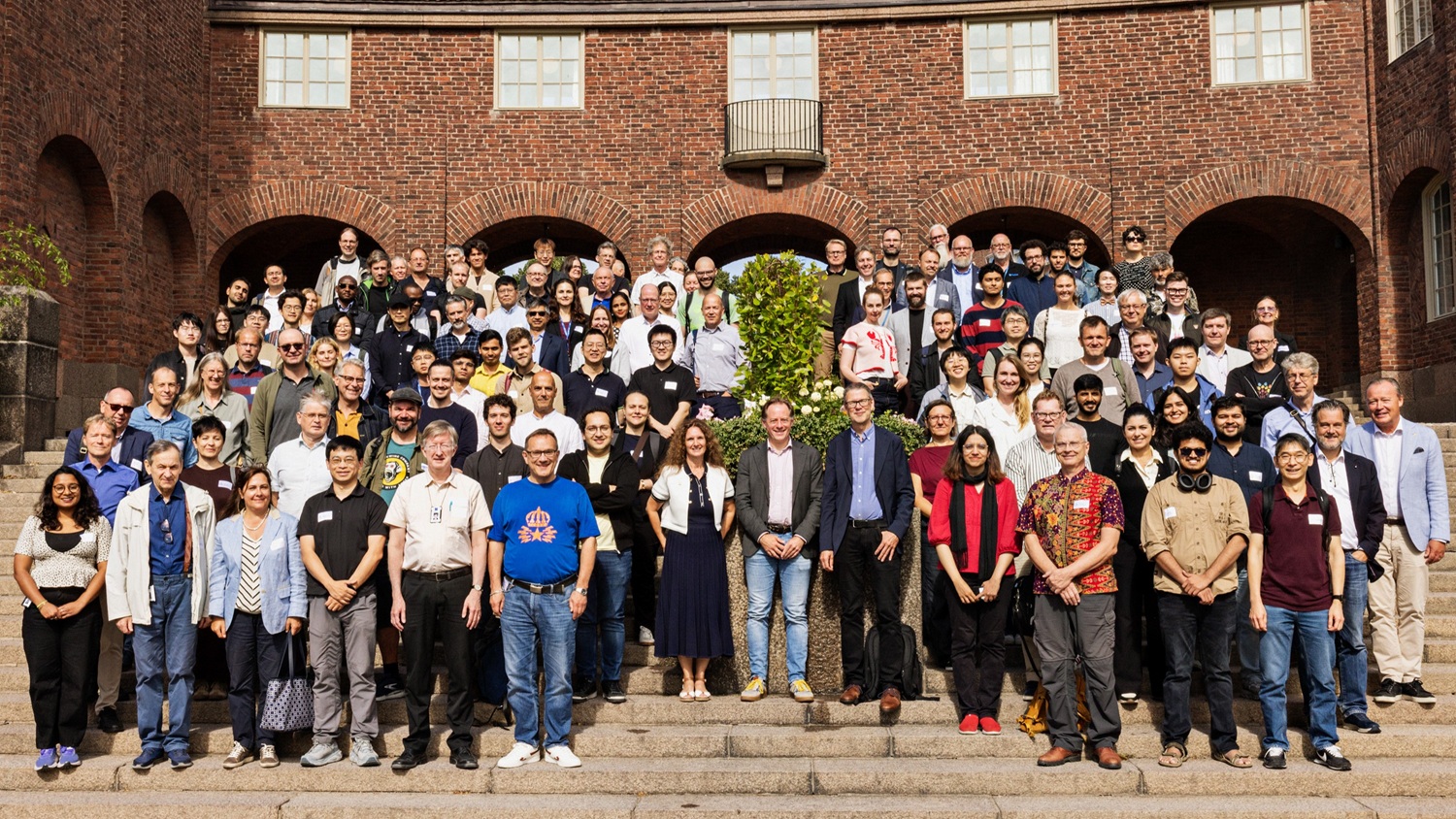
An air of anticipation filled the Alfvén Hall as researchers, students and guest lecturers gathered to engage with the latest frontier research. For the third consecutive year, the EECS Research & Impact Day was a bustling meeting place with an agenda that spanned a wide range of fields, from global AI trends and large-scale research infrastructure to revolutionary medical technology and intimate interaction design.
Welcome and Opening Remarks

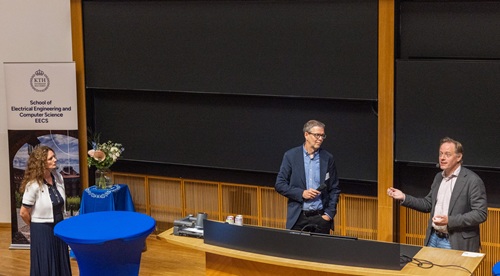
The atmosphere was inspiring as the driving force behind the EECS Research & Impact Day, Lina Bertling Tjernberg – Professor, Deputy Head of School and moderator for the day – took to the stage to open the programme . This was the third edition of the event, which serves as an inclusive forum that focuses on research dialogues as well as a warm welcome back from the summer break. You can read more about the previous editions here: 2024 med fokus på hållbar utveckling, resiliens och innovation and 2025 med fokus på den digitala framtiden .
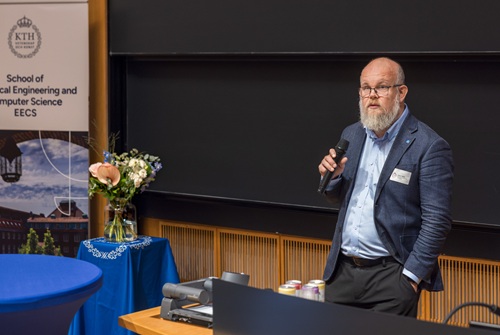
After welcoming the assembled audience and expressing her expectations for the event, Lina passed the floor to Joakim Jaldén, Head of School for EECS.
“One of the perks of being Head of School is that you get to stand up here and say welcome everyone back from holiday,” Joakim began, before introducing the seminar’s first major segment, which focused on the explosive advancement of artificial intelligence.
The Current State of AI: National and International Perspectives
Jörgen Gustafsson, Head of Ericsson AI Research, took to the stage to offer a telecom perspective on the global AI race. His insights painted a picture of a global market where investment in the US and China is setting the pace, and placing high demands on European players. The US invests approximately 20 times more than China in second place, which in turn lies far ahead of the rest of the world.

“We can’t only rely on the US. Not just because the US administration might one day push the stop button, but also because of critical infrastructure requirements”, Jörgen explained, highlighting why Ericsson collaborates with companies such as the French AI firm Mistral.
He also highlighted the acute shortage of compute power, and took up the massive efforts being made to deploy new supercomputers at the
Wallenberg AI Factory
.
“We’re starting to be in a compute-limited situation, compute is expensive and we have to be very efficient using it”, he added.
The discussion took on an even broader perspective when Fredrik Heintz took the floor. Heintz is a Professor at Linköping University, serves on the EU's AI Act Scientific Panel, and is one of the most prominent AI researchers in Sweden. He arrived directly with the very latest insights from a major AI conference held by the
International Joint Conferences on Artificial Intelligence (IJCAI)
.
“Today the best models are so good that we basically can’t measure how good they are on traditional human scales”, he made clear.
During the subsequent panel discussion, he issued a strong warning that Europe risks falling behind unless we invest heavily in frontier research, levelling criticism at the traditional academic system:
“My expectation is that the current scientific publication system will crash completely. Reviewing 40,000 submissions at a single conference, most probably AI-generated — what's the point?”
The Science Behind the Intelligent Systems of the Future
How these staggering AI trends are impacting academia from within was discussed during the first panel debate, which saw researchers from various EECS departments take the stage. Lina Bertling Tjernberg invited the panellists to share their thoughts following the initial presentations on AI.
Jana Tumova, Associate Professor of Robotics, Perception and Learning, offered a more nuanced take on the techno-optimistic view.
“There was a lot of excitement and buzz about the trends. But we didn’t discuss how much compute this costs us, how it might make our students less skilled in writing or how it might make us lazy. Every coin has two sides, and we need to think about that as well”. She also highlighted the importance of neuro-symbolic computing and risk awareness for ensuring that AI functions effectively in extreme physical environments.

Bo Peng, Associate Professor of Computational Science and Technology, agreed on the need for reflection, especially regarding undergraduate education.
“We must ensure students don’t think it’s not worth spending time learning fundamentals. We still teach maths and logic because it’s crucial to develop an intuitive grasp of the basics”, she reasoned, emphasising the importance of humans not trusting AI tools like Copilot blindly, but retaining control instead.
David Broman, Professor of Software and Computer Science, questioned the sustainability of only building larger models.
“Looking at the budgets and money being poured into bigger models and GPUs, this process has to end at some point. Improving purely by spending more money and using more data must hit a limit somewhere.”
The issue of efficiency was expanded on by Mikael Skoglund, Professor of Communication Theory, who focused on how AI’s data usage consumes massive amounts of energy.
“Large Language Models appear intelligent because they speak our language, but intelligence involves robustness, adaptability, autonomy and wisdom”, he explained, adding that we are currently building systems we do not yet theoretically understand.
Vitaly Petrov, Assistant Professor of Communication Systems, addressed the fact that AI often produces results that are merely "good enough”.
“Current models might have high average accuracy, but a 20% error rate is unacceptable for mission-critical tasks like wireless communications”, he warned, and called for new ways to teach students how to critically evaluate AI outputs rather than passively accepting them.

Intelligent Technologies Transforming the Life Sciences
Following a coffee break and a group photo in the marquee, the focus shifted to the life sciences, and the audience was introduced to ground breaking innovations and exciting projects that blur the line between technology and biology. Lina began by explaining:
“This panel will provide a taster of the research from across different EECS departments, all of which share a focus on the life sciences. During the latest school leadership’s tour of various research infrastructures, they also visited
SciLifeLab
– where our next speaker is based.”

The first speaker was Gisele Barboni Miranda, Assistant Professor of Machine Learning for Computational Biology, who is affiliated with SciLifeLab. She talked about how advanced image processing and machine learning are used to understand cells and diseases on a nanoscale. One of her core projects focuses on dermatology and examines how tape stripping and atomic force microscopy (AFM) can be used to analyse skin barrier integrity in conditions such as eczema
“We’re here on this what we call data-driven life science, so we have a lot of data, we have community resources that were built up in a collaborative way. How are we extracting information from these large resources? And that’s where my research is focused.”
Next, Saul Rodriguez, Professor of Electronics and Embedded Systems, demonstrated how integrated medical electronics and miniaturised systems can save lives and reduce healthcare costs. He illustrated this with a miniature ASIC chip for a skin cancer sensor that enables rapid differentiation between healthy cells and melanoma.
“In normal tissue, the cells are very homogeneous and have the same chemical content. The cells with cancer, on the other hand, are non-homogeneous”, he explained, and demonstrated how the impedance signature across different frequencies can identify cancerous cells. He also highlighted projects involving battery-free, wireless implants as well as sensors designed to monitor fetal oxygen levels during labour and delivery.
The final speaker in the Life Sciences panel was Federico Ribet, Researcher at the Department of Micro and Nanosystems and CTO of
Samplimy
. His passion for decentralised blood testing was obvious. He described venipuncture as “invasive” with “logistical complications”, and argued that not even today’s finger-prick sampling is good enough.
“‘Third-generation technology’ should be extremely simple, completely painless and done in one step. Basically, you just press a button and collect the sample right away”, he explained, and described how their microneedles can extract both blood and dermal interstitial fluid, which is then dried and can be sent by regular post.
Research Infrastructures and Laboratories at EECS
KTH’s research infrastructures bring together cutting-edge expertise and advanced resources to develop ideas and solutions in collaboration with researchers, industry and societal stakeholders. The seminar’s last panel showcased some of these facilities, with presentations from several EECS departments.

Andris Vaivads, Professor of Plasma Physics, outlined the work on the EXTRAP T2R fusion plasma device as well as the commercial collaboration with the
Novatron
company. He also shed light on the extensive space research projects, in which students and researchers are currently building instruments for sounding rockets.
“Because behind all this experimental research infrastructure there’s also engineering. It’s really important what’s happening in the lab, because it’s not just a metal piece, it's also what is in the heads”, he explains, and is especially pleased with the deep involvement of young engineers and students in the activities at
KTH's Makerspace
.
Next, Patrick Norman, Director of the KTH Center for Scientific Computing (KCSC) , took the floor. He detailed the capabilities of the Dardel supercomputer and the new centre’s mission to drive sustainable scientific software development in close collaboration with industry.

“As of 2025, AstraZeneca has converted to use our software as the main quantum mechanical research software for all of their components in the value chain, all the way from discovery through development and lead to production of all of their drugs.”

Björn Thuresson, Director of the
Visualization Studio (VIC)
, provided the audience with an energetic insight into an environment that thrives on creativity and interdisciplinary collaboration. VIC not only provides research support and application development within the national
InfraVis network
, it also maintains a prominent educational profile.
“Basically, we’re teachers of course, but we also have a number of other programmes coming in and using the facilities. We also provide a lot of equipment support and assist people in trying to use these new types of technologies”, he explained. He also highlighted their extensive alumni network, whose members are currently active in sectors such as the gaming industry.

Then Carina Zaring, Director of the
Electrum Laboratory
, presented and described a substantial research infrastructure of 1,300 square metres for the manufacture of advanced semiconductors and microcomponents.
“It’s only your creativity that determines how far you can go with your ideas for research and/or company”, she urged, pointing to the enormous possibilities on offer, especially in the new pilot line for power electronics that currently being established.

The infrastructure panel was concluded by Patrick Janus, Director of the
Sustainable Power Lab
. Despite being relatively small compared to KTH's other research infrastructures, the laboratory serves as a central hub for research into high voltages and high currents.
“We provide services in the form of equipment, personnel that are trained in that equipment, and we can help you out with your research”, he clarified, and mentioned that they had recently conducted collaborative projects to simulate lightning strikes in their facilities.
The Intimate Body and Technology
The closing keynote speaker, Madeline Balaam, Professor of Interaction Design, gave a presentation on intimacy and technology. Her cross-disciplinary research receives funding from the European Research Council project .

Her research group examines the complex intersection between technology and the intimate body with the aim of developing safe and reassuring design methods for sensitive issues.
Instead of treating technology as cold tools, Balaam investigates how algorithms, software and sensors can be designed with empathy, sensitivity and consent when operating close to – or even inside – the human body.
She illustrated the research using four of the group’s projects: from “Tactful Sensor”, a soft gynaecological sensor, and the touch-sensitive “Pelvic Chair” , to Photobooth, which highlights the downsides of deepfakes, and ongoing studies into generative AI in commercial sex toys.
Common to all these projects is a desire to provide the engineers and AI developers of the future with concrete frameworks for how technology should interact with humans in a reassuring and dignified way.
Best Poster Award

Next, it was time for the poster competition award ceremony. The competition was fierce, but once the judges had made their decision, Kajornsak Kittimathaveenan, PhD Student in Virtual Acoustics & Choir Singing, claimed victory with his poster “Hear here: Does where you stand change how you sing?”. A visibly proud Kajornsak, who works for Speech, Music and Hearing, accepted the applause, certificate and flowers.
The KTH bicentenary– passing the baton forward

Following the award ceremony, all eyes turned to the future – to next year’s major celebrations marking KTH’s bicentenary . Moderator Lina Bertling Tjernberg wrapped up the afternoon by passing the baton to Roberto Bresin, Director of the NAVET centre (a centre for research in art, technology, and design), who concluded by presenting the school’s exciting initiatives ahead of the jubilee year.
At the intersection between art, technology and science, NAVET is planning several exciting projects, including a permanent, interactive sound and light installation that will be built in the square behind the School of Architecture building.
“The first installation will be a representation of space plasma, also in honour of the unique Nobel prize winner we have here at KTH, Hannes Alfvén”, he explained.
Afterwards, the moderator, Lina Bertling Tjernberg, took the floor one last time.
“So now it’s time to close for today! I’d like to thank everyone who participated and contributed”, she said, offering special thanks to the administrative staff who had worked so hard to make the day a reality.