
Three key themes – New projects 2026 in ‘Future Education at KTH’
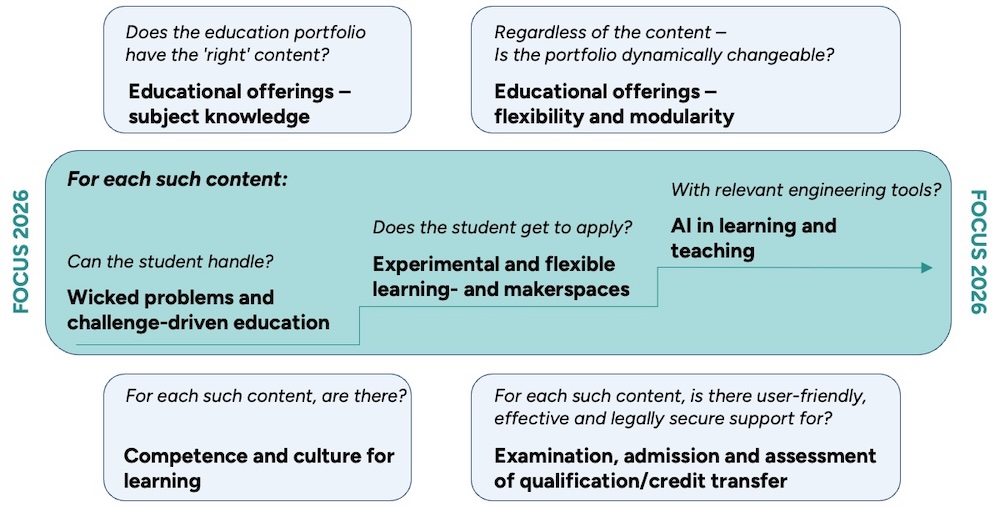
The 30 or so development projects launched in 2026 can be broadly categorised into three themes: 10 projects under the theme ‘intractable problems’, seven projects under ‘experimental and flexible learning and maker environments’, and 12 under ‘AI and education’. In addition to these development projects, which have been launched and are being carried out across all five of KTH’s schools, six KTH-wide projects are currently underway, and more may be added during the year.

Thematic selection criteria for school projects
Following a proposal from the Future Education programme management and discussion within the Core Team (all Directors and Deputy Directors of First and Second Cycle Education, THS Student Union representative and the Dean), it was decided that proposals for the 2026 development projects should primarily relate to:
- understanding and managing wicked problems
- teaching and pedagogy linked to the initiative for all schools to establish makerspaces
- Education with AI.
The same themes for the programme analyses in the quality system
The same themes are also used in the quality assurance work within education, which this year focuses on analyses of KTH’s degree programmes. ‘Education of the Future’ has been tasked by the Faculty Council with leading workshops with programme directors (PDs) on the same themes during late spring and autumn.
Different timetable for KTH projects
In addition to the development projects initiated and underway at all five of KTH’s schools, six KTH-wide projects are currently underway, and more may be added during the year. The KTH-wide projects may follow a different process and timetable from the schools’ project proposals. Of the six (currently) active projects, three have published websites.
Wicked problems and challenge-driven education
Do students have the ability to deal with wicked problems? For all components of the education portfolio, do we conduct challenge-driven education (CDE)?
Sociotechnical systems understanding for dealing with wicked problems (2626-ITM)
Teaching discrimination as a wicked problem (2623-ITM)
Learning activities for wicked problems and goal conflicts between industry and society (2622-ITM)
Project-based courses 2.0 (2617-EECS)
Managing wicked problems in clinical environments (2610-CBH)
Wicked problems in sustainable development for chemistry education (2609-CBH)
Three-stage rocket in ethics (2607-ABE)
Wicked water – teaching wicked problems in water resource management (2606-ABE)
The Sustainability Lighthouse – a Makerspace concept for wicked problems and AI (2605-ABE)
Collaborative urban planning: teaching for wicked problems (2604-ABE)
Experimental and flexible learning- and makerspaces
Can students apply their knowledge and skills in flexible and experimental learning- and makerspaces?
Maxi-studios and multimedia for enhanced learning (2632-KTH)
SCI MakerSpace – pedagogical integration and course development (2629-SCI)
Hybrid entrepreneurial makerspace ecosystem – HEME (2625-ITM)
MLSpace – a step towards crucial infrastructure for the Machine Learning/AI era (2613-CBH)
KTH Makerspace Network – establishment and cooperation (2608-KTH)
Makerspaces – a model for open experimental learning environments at KTH Architecture (2603-ABE)
Showcase KTH Arkitektur: en demonstration av designstudio-pedagogiken (2602-ABE)
AI in learning and teaching
Do we actively use AI in learning and teaching? Is AI seen as an engineering tool in applications?
AI-adapted and assessable learning outcomes for KTH’s Master’s theses (2631-KTH)
AI-boost SCI: Pedagogical model, teacher competence and AI-resilient examination (2628-SCI) Läs om projekten på SCI's ongoing AI projects
AI and study skills: From cognitive laziness to effective learning strategies (2627-ITM)
AI in KPU – complementary pedagogical education – and other university education (2624-ITM)
AI-enhanced VR for learning abstract concepts (2620-EECS)
Together against the machine (2619-EECS)
Master thesis progress through peers and AI (2618-EECS)
Towards AI Literacy and Confidence – TALC (2615-EECS)
Grading methods and grade inflation in the AI era (2614-EECS)
Application of AI in biotechnology theses (2612-CBH)
AI in chemistry for deep learning and professional practice (2611-CBH)
Scalable interactive teaching with Jupyter: environmental physics and AI solutions (2601-ABE)

Projects in other themes
Examination, admission and assessment of qualifications/credit transfer
Do we have user-friendly, effective, and legally secure support for examinations, admissions, and assessment of qualifications/credit transfer?
The new project DDBMV – Data-driven decision support for assessment of qualifications to Master’s programmes (2634-KTH) is currently at the pre-study stage, where the results from the pilot project DDMV3 – Datadriven meritvärdering PilotHT26 (2526-KTH) are being evaluated.
Educational offerings – subject knowledge
Does the education portfolio have the 'right' components (subject knowledge) based on today's needs?
Electronic Defence – a multi-institution course with industrial commitment (2616-EECS)
The government investment in mathematics – Maths 2026 (2630-KTH) web page to come.
Competence and culture for learning
Do we have the relevant competence and culture for learning for all components of the education portfolio?
Collegially operated teacher conference (KDL) for teaching development (2621-EECS)