

SLICE-T
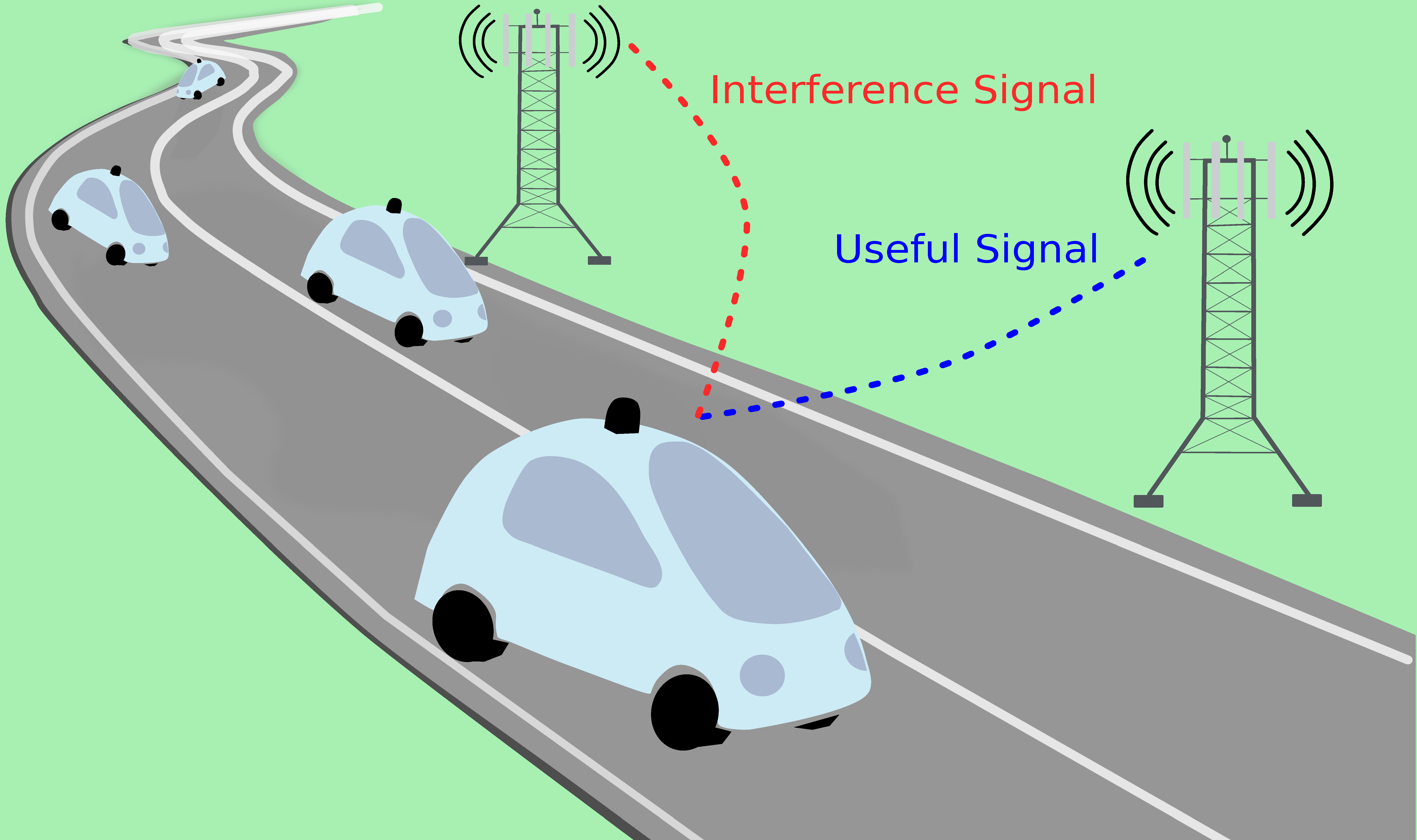
This project develops an interference-aware framework for power- and bandwidth-constrained cellular networks for transport and connected vehicle systems, jointly optimizing user association, resource allocation, and transmit power to improve reliability, throughput, fairness, and energy efficiency in mobility-driven, interference-limited environments.
Motivation
Mobile connectivity is no longer just a supporting infrastructure: it is becoming a core enabler of connected and automated transport systems. Modern vehicles, drones, and mobile robots rely on continuous wireless communication for navigation, coordination, sensing, remote supervision, and safety-critical control.
As transport systems evolve toward higher levels of automation and real-time coordination, wireless networks must meet increasingly stringent requirements in terms of reliability, latency, throughput, and energy efficiency. In dense urban corridors and traffic hotspots, these requirements are further complicated by intercell interference, limited spectrum resources, and power constraints.
Traditional network planning approaches often separate long-term infrastructure decisions (such as base station deployment) from operational resource allocation (such as power and bandwidth distribution). However, in interference-limited environments, these decisions are tightly coupled. Ignoring interference during the planning phase can lead to deployments that are inefficient, unstable, or unable to guarantee required service levels under realistic traffic conditions.
This project addresses this challenge by integrating interference-aware optimization directly into the network planning phase.
About the Project
The goal of this project is to develop optimization-driven, interference-aware methodologies for planning and operating wireless networks that support connected transport systems. We study how base station deployment, user association, power control, and bandwidth allocation interact under realistic propagation and interference conditions. Our approach explicitly incorporates intercell interference into both:
- Power minimization formulations, where the objective is to satisfy minimum rate requirements while minimizing energy expenditure.
- Rate maximization formulations, where throughput, fairness, and power trade-offs are analyzed under bounded rate constraints.
Smarter Network Planning for Connected Transport
To translate these research results into an interactive planning framework, we are developing the SLICE-T Control Center, a simulation and decision-support tool for network operators and researchers.
The Control Center is a prototype that aims at enabling operators to:
- Define a geographical service area of interest
- Place and activate base stations with different antenna models configuration
- Simulate demand-node distributions (e.g., vehicles along roads)
- Analyze rate distributions and fairness
- Evaluate power expenditure vs. achieved performance
- Study performance under different load conditions
The tool acts as a bridge between theoretical optimization models and practical network deployment decisions.



Publications
The methodology behind this project is documented in recent peer-reviewed IEEE publications:
- Towards Interference-Aware Power-Constrained Cell Planning, 2024 IEEE CSCN [LINK: https://ieeexplore.ieee.org/abstract/document/10849682 ]
This work introduces an iterative interference-aware framework for cell planning under power and bandwidth constraints, demonstrating improved rate feasibility and reduced energy expenditure in interference-limited deployments.
2. Interference-Aware Joint User Association and Resource Allocation, 2025 IEEE CommNet [LINK: https://ieeexplore.ieee.org/abstract/document/11288890 ]
This paper extends the framework to jointly optimize user association, bandwidth allocation, and transmit power while explicitly modeling intercell interference. The results quantify trade-offs between throughput, fairness, and energy consumption.