DISSECT; Digital twins and decision support for flexible energy management in electrified groundwork construction
Project name: Digital twins and decision support for flexible energy management in electrified groundwork construction (DISSECT)
Project leader:
Gyözö Gidofalvi
, Geoinformatics, SoM
Other participants from KTH:
Jonas Mårtensson
,
Qianwen Xu
,
Mohammad Reza Hesamzadeh
(EECS)
Participating universities/companies/other organisations: CFT Sweden AB, Hitachi Energy Sweden AB, Infrakit AB, Pure Energy AB, Stockholms kommun, Svevia AB, VABEKO AB, Vattenfall AB
Project period: 2026 09 01 - 2028 08 31
Financing: Vinnova
Aim:
Develop and demonstrate data-driven decision support for flexible energy management in electrified groundwork construction using digital twins.
Summary:
Electrified groundwork construction is essential for achieving climate targets, but it introduces significant site-specific challenges due to high and variable power demand under constrained grid capacity. Current planning practices lack integrated decision support and often lead to overestimation of power requirements and underutilization of available flexibility.
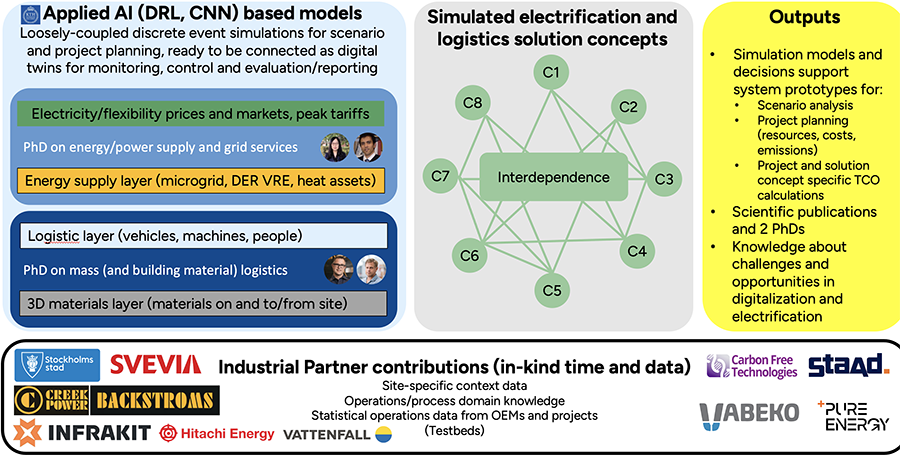
DISSECT develops data-driven decision support for flexible energy management in electrified groundwork construction. The project integrates material flows, construction processes, logistics, charging infrastructure, and energy systems into modular digital twins that enable scenario analysis, planning, and operational follow-up.
Based on the results of preREGULA , the project demonstrates that power demand can be significantly reduced (e.g. from approximately 5 MW to 1.2 MW or lower), while simultaneously quantifying and utilizing flexibility potential.
The project is carried out by a broad, industry-anchored consortium comprising the City of Stockholm, Svevia, Infrakit, Vattenfall, Hitachi Energy, Carbon Free Technologies, Creek Power, Pure Energy, Vabeko, Staad, and KTH. This ensures access to real project data, operational needs, and implementation environments. The project results will be integrated into a commercial platform and can be scaled through procurement and deployment across multiple projects, enabling impact beyond the project itself and contributing to reduced peak power demand, improved resource efficiency, and a more flexible electricity system.
Contact