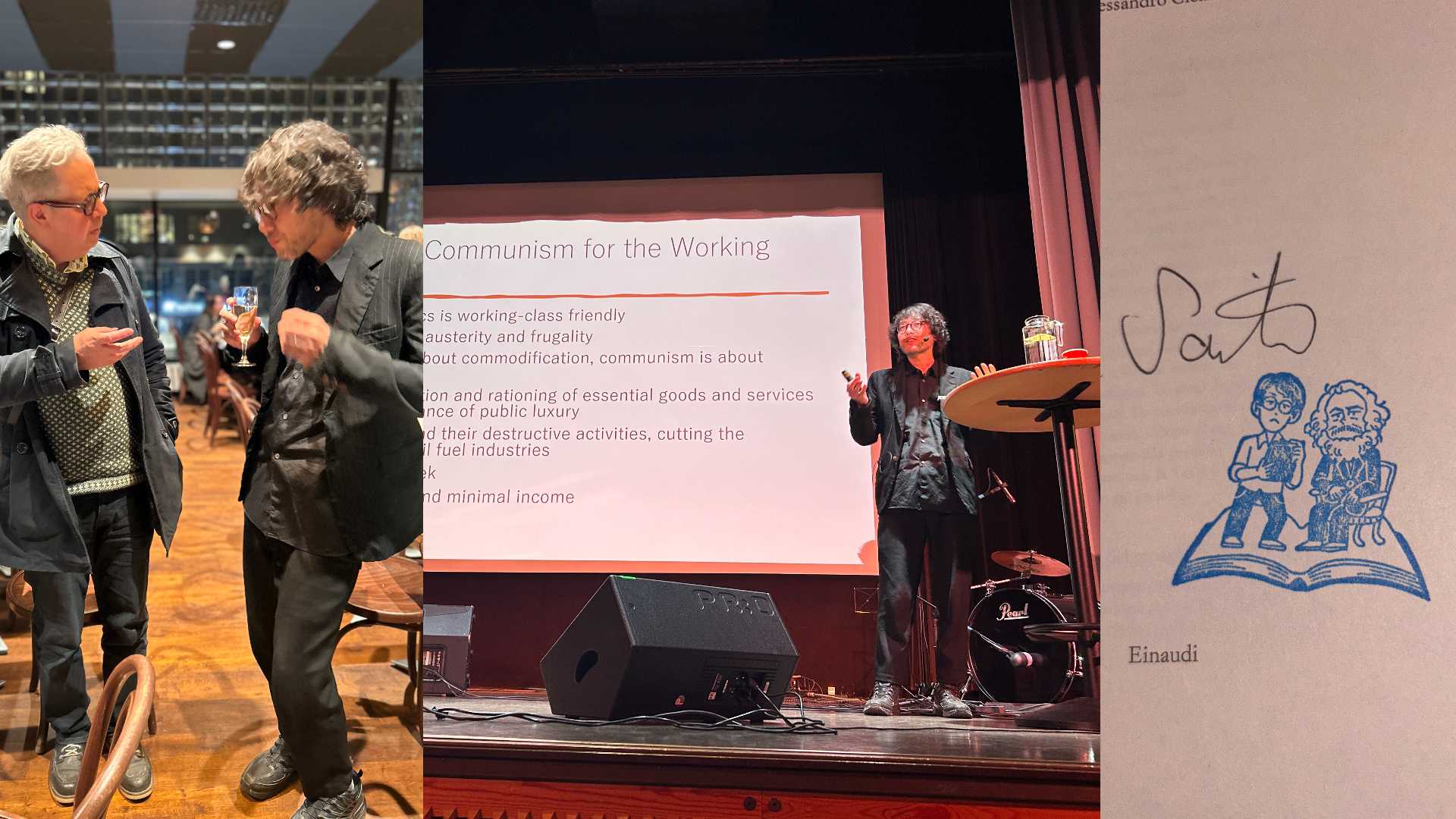
It was a bit surprising, seeing the Zätasalen at Arbetarnas Bildningsförbund, completely full, to listen to an academic talk on a rainy Saturday night in Stockholm. For those not familiar, this is the premier space at
ABF
, a long-standing worker’s education and cultural center, and it holds almost 350 people. There were about that many people on November 8 to hear Kohei Saito talk about eco-socialist degrowth for the fourteenth annual KTH Environmental Humanities Laboratory Archipelago Lecture.
When we first contacted Saito last summer and he said a visit to Stockholm would fit into his schedule, we thought it might be a popular event. His books, especially Slow Down: The Degrowth Manifesto, have been worldwide bestsellers, are widely discussed in the Swedish media, and the first
Swedish language edition of Marx in the Anthropocene
was just released in November. To appeal to a broader audience, we partnered with ABF because of their commitment to education for a democratic society.
After initially booking one of their smaller rooms, it quickly sold out, so we moved to the Zatasälen, which also filled up. This was also not completely surprising. Saito is a well-known speaker, at a great venue, and we also partnered with
Arena Idé, a progressive think tank,
to promote the event. But what was a bit unexpected was the engagement level of the audience and the energy they had for ideas that can be quite challenging, from both an intellectual and social perspective.
Saito spoke for about an hour, and gave a broad overview of his research on Marx and approach to degrowth. From a scholarly perspective, what has been innovative about his work is a subtle and robust exploration of Marx’s later writings, primarily notes, excerpts and other marginalia. He argues that far from being a strident techno-modernist, in the later years of his life Marx showed significant concern what we would today call environmental sustainability, becoming thoroughly engaged with the natural science and geologic debates of the day, especially around soil depletion. Saito, who helped edit many of the these documents for
a recent volume of the Marx-Engels-Gesamtausgabe
(Marx Engels Collected Works), uses his analysis to build a reinterpretation of Marx and communist ideology that can be deployed in a world where the demands for justice and sustainability are equally urgent.
The lecture provided an excellent and engaging overview of these ideas, and so I encourage everyone interested to take time to
view the video.
After he finished we had about 45 minutes for questions, and hands shot up in the air. Although the implications of Saito’s ideas are quite radical for a society still built on private property and profit accumulation, there was no outright critique. Questions and comments were engaging and searching, asking how ecosocialist degrowth could be put into practice, especially at different scales and in various social and cultural contexts.
Saito did not have all of the answers, but although you could tell he had heard many of these questions before, he worked to genuinely connect with each inquiry. After the talk we had a mingle in the Cirkeln restaurant, and he gamely signed copies of Marx i antropocen for almost an hour. Right next to each signature, he put his wonderful little personal stamp of him sitting with Marx.
When you host events like these, you hope that the lecture is engaging and interesting, that your speaker connects well with the audience. And that was a great success. But what was most encouraging was the age and energy level of the audience. By observation the majority of attendees were under forty years old, with many in their twenties. From their questions and discussion afterward, you could tell that although everyone might not fully agree with degrowth communism, they were very open to alternatives to our current approach to the green transition.
And this is why it is so important to host talks like the Archipelago Lectures, where new and sometimes radical ideas are shared and discussed, to help us move forward in our collective thinking and action for a more hopeful future. A great thanks to Kohei Saito for leaving us with great food for thought that hopefully the audience can take with them onwards in conversation with others, sprouting fruitful discussions, inspirations and acts.