
Space food: Beyond survival
A round trip to Mars takes several years. What will the astronauts eat when they cannot replenish their supplies along the way? KTH researcher Tor Blomqvist is studying the food systems that will be needed when humans live far from Earth.
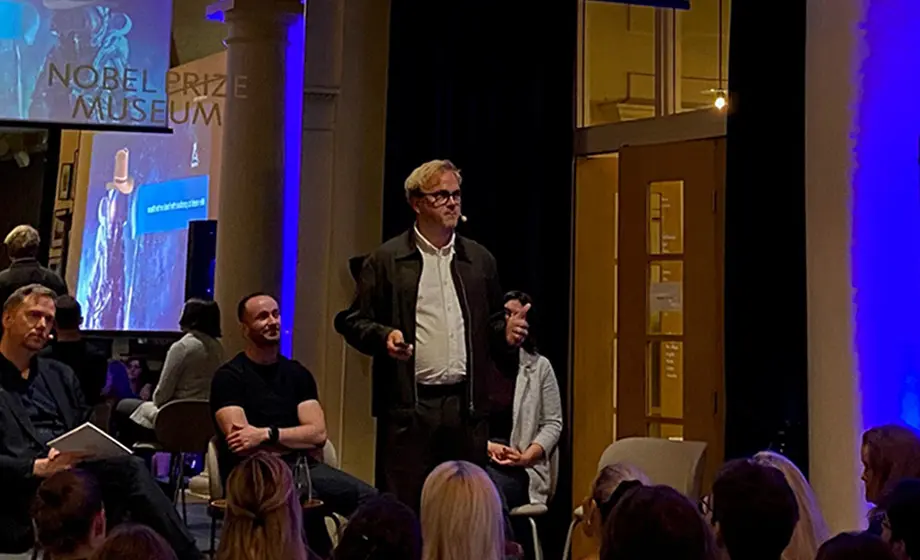
One of the questions explored when researchers from KTH, Karolinska Institutet and Stockholm University gathered at the Nobel Prize Museum for Science Today , themed 'Humanity in Space, was how humans can live in space for extended periods. At the event, KTH FOOD researcher Tor Blomqvist highlighted one of the most fundamental requirements for future missions to Mars: food.
“Food is a limiting factor for human spaceflight,” Blomqvist says.
Human space travel is entering a new phase, with plans for long-duration outposts on the lunar surface and future missions to Mars. The farther humans travel from Earth, the more difficult it becomes to rely on pre-packaged food and resupply missions.
Blomqvist’s research examines how future space food systems can evolve from today's prepackaged meals to systems where crews produce some of their own food. This involves much more than growing a few plants. The entire process must function, from cultivation and post-harvest handling to processing, storage, food safety, waste management, sanitation, habitat resources and integration with the spacecraft’s life-support systems. Simply providing astronauts with enough calories and nutrients to survive is not enough.
“Food is for health and performance, not just survival,” Blomqvist says.
Food also needs to be something that people actually want to eat.
“Astronauts are people just like the rest of us, and they need good food too. This is especially true for those travelling to Mars on a three-year round trip. Just imagine the existential anxiety they'll experience up there! The only thing that can ease that anxiety is grandma’s meatballs,” he says with a smile.
KTH FOOD conducts research on sustainable and healthy food systems, focusing on the entire chain, from production and processing to consumption and circular flows. In space, the same systems approach is pushed to its limits, with food systems facing very different and considerably more challenging conditions. Meeting these challenges requires expertise from fields far beyond space engineering.
“If we are to succeed in space exploration, we must involve people from all disciplines, including economists, architects, and psychologists. Not just engineering and the natural sciences.”
For Blomqvist, exploring space can also teach us something fundamental about ourselves.
“It is only when we are up in space that we understand what it means to be human.”
He hopes that more Swedish researchers will become interested in this area of study.
“I am the only person in Sweden working on space food, and I would like some company.”
Sofia Tatsis