
Mapping the Cost of LPG Cooking in Sub-Saharan Africa
Liquefied Petroleum Gas (LPG) plays a central role in the transition to clean cooking across Sub-Saharan Africa (SSA). However, the price of LPG varies widely between and within countries due to differences in supply chains, infrastructure, and distribution networks. This thesis aims to analyse the LPG supply chain to better understand how each component—from import to household use—contributes to the overall cost of cooking. The outcome will be a proposal or prototype for a Levelized Cost of Cooking (LCOC) framework tailored to the SSA context.
Background
Despite the global push toward universal access to clean cooking, adoption of clean cooking fuels in many SSA countries remains limited. While much of the discussion focuses on demand-side barriers such as affordability or behavioural factors, the supply-side determinants of cost and price variability are often underexplored.
The LPG supply chain in SSA is complex and highly context-dependent. It involves multiple stages—import terminals or refineries, bulk storage, cylinder filling plants, transport logistics, and last-mile distribution. Each stage introduces costs and risks that ultimately shape the retail price faced by households. Retail price itself presents in many different ways due to the myriads of new micro-financing schemes. Factors such as road accessibility, distance to urban centers, port infrastructure, and market competition significantly influence these costs, yet they are rarely quantified or represented in modelling exercises.
Current clean cooking models, such as OnStove, typically rely on simplified, spatially uniform LPG cost assumptions. While this allows for regional-scale comparisons, it overlooks the nuances of supply chain performance and geographic price heterogeneity. Developing a structured understanding of the LPG cost formation process—and how it translates into household-level cooking costs—would provide valuable insights for both policy design and future modelling efforts.
This thesis will therefore explore how LPG supply chain components and spatial determinants contribute to differences in cooking costs across SSA. The work will combine literature review, data synthesis, and modelling to propose or test a Levelized Cost of Cooking (LCOC) approach for LPG.
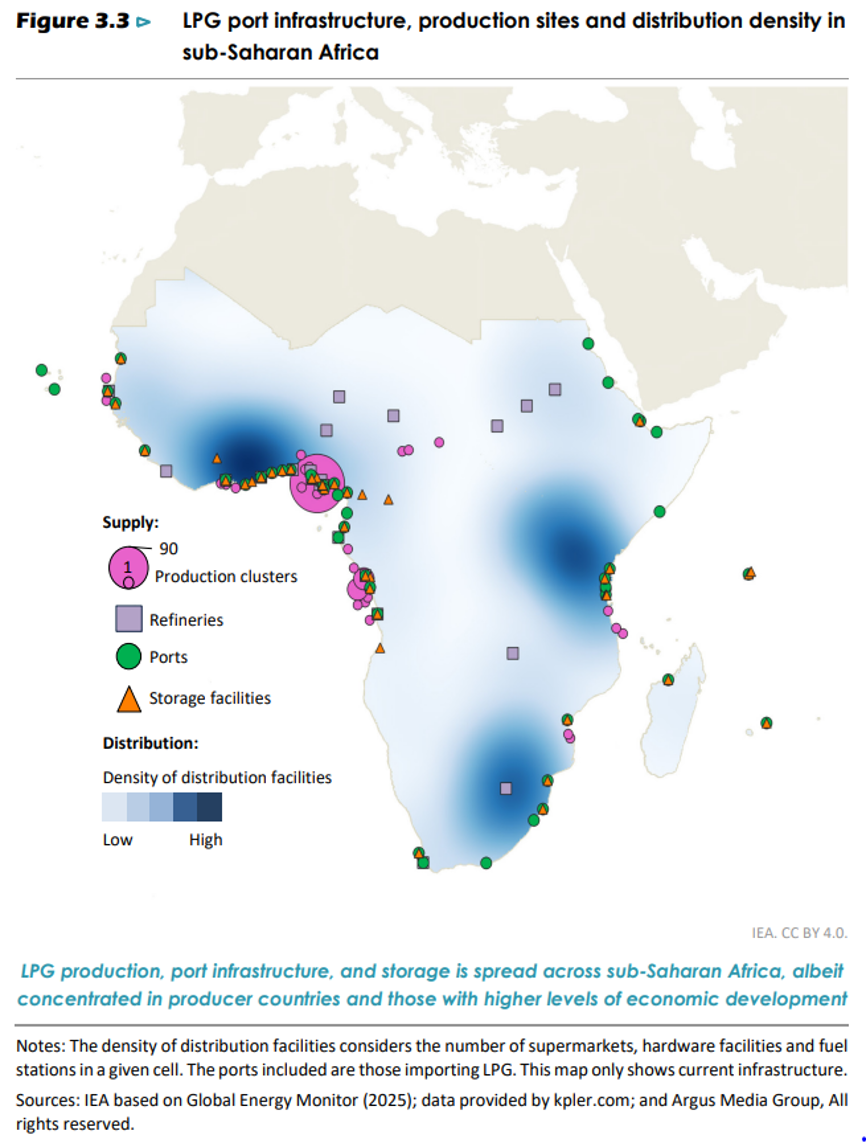
Key research questions may include:
-
How do different components of the LPG supply chain (import, storage, transport, distribution, retail) contribute to final cooking costs?
-
How do geographical and infrastructural factors (road access, urban proximity, supply hubs) influence LPG prices across regions?
-
What would a spatially explicit or parametric model of the LCOC for LPG look like in the SSA context?
-
How might shared-ownership or micro-financed business models (e.g. Pay-As-You-Go schemes) affect the LCOC and affordability for households?
Task Description
The thesis will begin with a literature review of LPG supply chains in Sub-Saharan Africa, focusing on how costs accumulate through production, import, transport, storage, and retail distribution. The student will collect and harmonize available data on LPG prices, infrastructure, and logistics from existing databases, national reports, or academic studies.
Based on this, the student will develop a framework for estimating the Levelized Cost of Cooking (LCOC) for LPG. The framework will aim to disaggregate costs into their main components (e.g., CAPEX, OPEX, fuel, distribution) and explore how geographic or infrastructural factors may affect each component. Depending on data availability, the analysis could evolve from a conceptual or parametric model into a spatially explicit representation for one or more countries (e.g., Kenya).
An additional dimension of the thesis will be to assess how alternative delivery models, such as Pay-As-You-Go (PAYG) LPG systems, influence the LCOC and end-user affordability. The findings could inform future geospatial or policy-oriented models, including tools like OnStove, to better represent LPG costs and adoption potential across diverse contexts.
Learning Outcomes
-
Gain a comprehensive understanding of the LPG supply chain and its role in the clean cooking transition in SSA.
-
Develop skills in data collection, harmonization, and cost modelling.
-
Learn how to structure and apply a Levelized Cost of Cooking (LCOC) framework.
-
Explore links between infrastructure, logistics, and household energy economics.
-
Strengthen analytical and research skills applicable to energy systems and development contexts.
Prerequisities
The project welcomes students from energy systems, sustainable development, or related fields. A strong interest in energy access, clean cooking, and techno-economic analysis is expected. Familiarity with Python, GIS, or data analysis is advantageous but not mandatory. A balanced approach combining qualitative and quantitative analysis will be encouraged.
Duration
5–6 months, start January 2026.
Specialization track
Transformation of Energy System (TES) - Division of Energy Systems
Division/Department
Division of Energy Systems – Department of Energy Technology
How to apply
Send an email expressing your interest in the topic to Camilo Ramirez Gomez (camilorg@kth.se) and Manuel Enrique Salas (mess@kth.se).
Supervisors


Examiner

Key Literature
- Chen, K. C., Leach, M., Black, M. J., Tesfamichael, M., Kemausuor, F., Littlewood, P., Marker, T., Mwabonje, O., Mulugetta, Y., Murphy, R. J., Diaz-Chavez, R., Hauge, J., Saleeby, D., Evans, A. W., & Puzzolo, E. (2021). BioLPG for Clean Cooking in Sub-Saharan Africa: Present and Future Feasibility of Technologies, Feedstocks, Enabling Conditions and Financing. Energies, 14(13), 3916. https://doi.org/10.3390/en14133916
- IEA International Energy Agency. (2025). Universal Access to Clean Cooking in Africa (World Energy Outlook Special Report). Directorate of Sustainability, Technology and Outlooks. https://www.iea.org/reports/universal-access-to-clean-cooking-in-africa
- Khavari, B., Ramirez, C., Jeuland, M., & Fuso Nerini, F. (2023). A geospatial approach to understanding clean cooking challenges in sub-Saharan Africa. Nature Sustainability, 6(4), 447–457. https://doi.org/10.1038/s41893-022-01039-8
- Nshimiyimana, J. P., Mukeshimana, M. C., & Nshimyimana, E. (2024). Tracking the progress towards adopting LPG as a clean cooking fuel in Rwanda: User’s perspective. Energy for Sustainable Development, 80, 101441. https://doi.org/10.1016/j.esd.2024.101441
- Perros, T., Lisa Allison, A., Nabukwangwa, W., Mwitari, J., Kavuli, P., Chepkirui, W., Rosa, G., Shupler, M., Pope, D., & Puzzolo, E. (2024). Understanding drivers of fuel stacking among pay-as-you-go LPG customers in Nairobi, Kenya. World Development Perspectives, 35, 100622. https://doi.org/10.1016/j.wdp.2024.100622
- Perros, T., Tomei, J., & Parikh, P. (2024). Stakeholder perspectives on the future of clean cooking in sub-Saharan Africa and the role of pay-as-you-go LPG in expanding access. Energy Research & Social Science, 112, 103494. https://doi.org/10.1016/j.erss.2024.103494