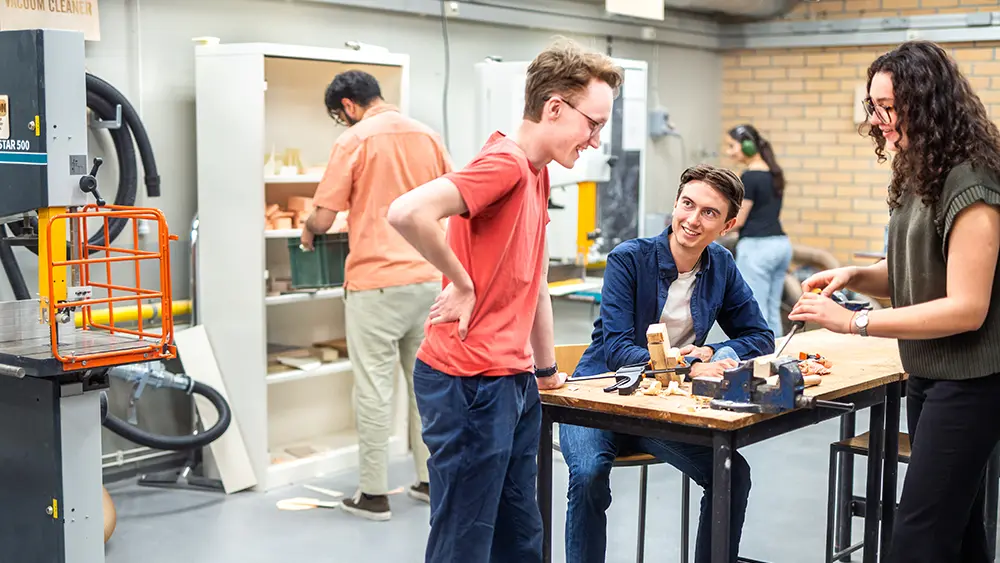
Students working together at KTH Prototype Center.
As part of KTH’s vision and the initiative Future Education at KTH, makerspaces are being developed as shared educational infrastructures for hands-on, project-based, and interdisciplinary learning. These environments support new ways of integrating theory and practice, enabling students to learn through designing, building, testing, and iterating in response to real-world challenges.
Makerspaces at KTH
On the Student web you can see all makerspaces available at KTH.
KTH is building a new
makerspace in KTH Library
and evolving current specialised makerspaces at the schools. The project aims to strengthen makerspaces as common educational infrastructure, and evolve the learning environment at KTH.
A university makerspace is an open and inclusive physical space where experimental learning, hands-on design, prototyping, testing and exploration can happen. It forms a flexible workspace with tools, equipment, materials, and human support. This is achieved through the values of the international makerspace movement.
Traditional engineering education often separates theory from practice. Makerspaces support a more integrated learning model where students develop understanding through iterative design, prototyping, experimentation, and reflection throughout their education.
Makerspaces also help students learn how to work with AI as an engineering tool rather than relying on AI as a substitute for engineering understanding.
In short, makerspaces are learning environments where:
Theory and practice are integrated throughout the course.
Learning is an iterative process.
Experimentation is part of the process of understanding.
Engineering practice is seen as a process of designing, building, testing and iterating.
Students learn how to work with AI as an engineering tool.
Equipment and resources at makerspaces
Makerspaces at KTH combine flexible workspace with tools, machines, materials, and human support so that students and teachers can move from ideas to physical artifacts through iterative design.
The value of a makerspace is not in the machines and tools themselves, but in enabling students to connect theory to practice by making, testing, and improving ideas in the world. For teachers, a makerspace lowers the barrier to offering this kind of work by providing shared space, tools, materials, and support.
Depending on the facility, makerspaces may include equipment and resources like:
Fabrication tools such as 3D printers and laser cutters.
Electronics equipment.
Hand tools.
Computers for digital design.
Open areas for assembly and collaboration.
How can makerspaces be used in teaching?
Makerspaces can be used in many ways in teaching, for example through:
Short prototyping exercises.
Design assignments.
Lab extensions.
Larger project-based learning experiences.
Here you can find case studies, interviews, and examples as inspiration for how to integrate them in courses.
They tested Bluetooth in a makerspace
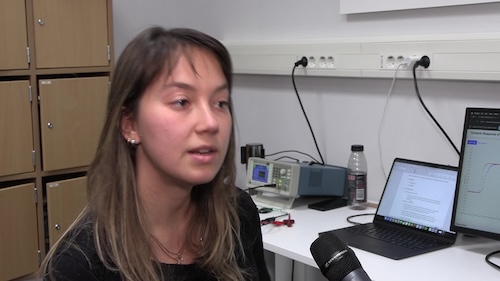
Joel and Johan are in their first year of Electrical Engineering, 180 credits. Hear them talk about a project at KTH Spaces in Flemingsberg where they are testing Bluetooth connectivity.
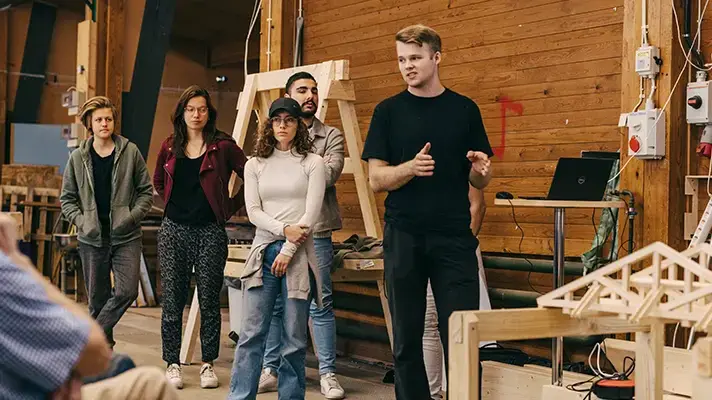
Architecture and engineering students collaborated to develop a design for a 10-meter-long wooden bridge for pedestrians and cyclists. The winning design was built in five days at Brosenius Hall on KTH Campus.
What is the pedagogical value of open learning environments, and why is it essential that they are open and accessible to students? Watch a video about the makerspace Spaces at KTH Flemingsberg.
What do teachers and students think of makerspaces?
The makerspace Spaces has been in operation at KTH Flemingsberg since 2019. Here, the space’s director and students explain what Spaces has meant for teaching and learning.
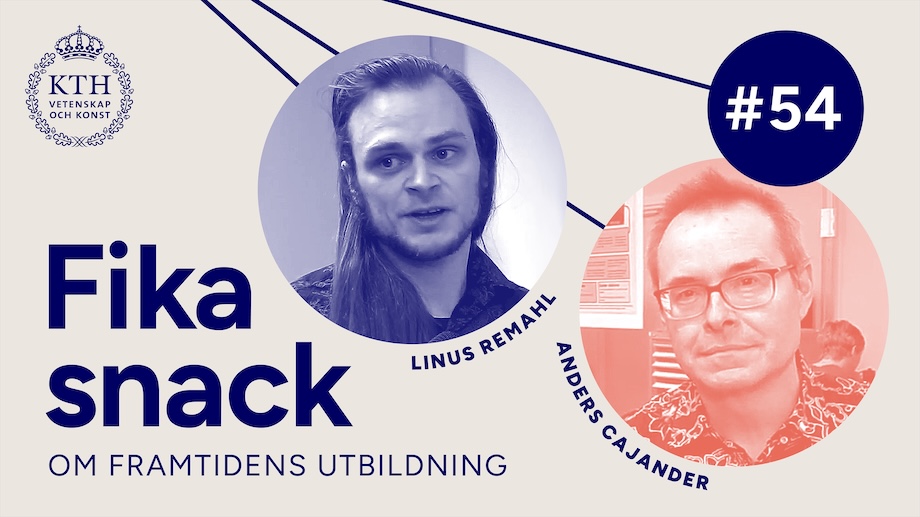
Anders Cajander, Director of Spaces
"For Bachelor's of Science, the intention is that students should be employable and immediately effective in working life. From that perspective, experimental environments are a natural choice, where students can really put their theoretical knowledge into practice and get hands-on experience of what industry expects them to be able to do.
When it comes to master's programmes, it is extremely important to be able to try things out, as far as the programme allows. The interdisciplinary effect that arises can also provide skills that are helpful in research."
What do you think about coordinating maker environments?
"It is excellent if this is done with a central hub that points to specialised, distributed makerspaces integrated into education and research. I believe this will provide a cost-effective solution that also offers academic excellence.
If we only had a central makerspace, I think it would have been difficult to make it relevant to all areas of education at KTH. Spaces existed here before. The fact that it is now being highlighted and receiving financial support is greatly appreciated."
Max Gulda, Master's student
"Actually, this isn't my home environment anymore, but I still come here and hang out. What has been incredibly rewarding for us is the close contact with the doctoral students. There's a lot of sports technology here, and that's not what we study, but this is where different worlds can meet. The doctoral students can come up with an idea about something they want to measure on the body. Then we can come up with the other part – how to do it."
What has Spaces meant to you?
"I probably would have been less engaged in my studies otherwise. You take a lot of courses in a year. Then you have a project course, and that's when you can see what you've learned during the year that you can actually do something with. What employers ask for is your own projects. It's a profession that requires you to stay up to date all the time, which requires a genuine interest. Projects are a very important confirmation of that drive."
Jesper Sjöberg, Master's student
"It has been very beneficial for us students that it is integrated into the programme. It is an ideal place to be if you want to do your own projects, with access to all the machines whenever you want. The researchers have been impressively accommodating; you can talk to someone with 30 years of experience sitting in the same kitchen. It's a huge give and take from both sides, and we've gained a lot of knowledge and opportunities just from sitting there eating lunch. We wouldn't have done our current project if it hadn't been for that."
What has Spaces given you?
"What hasn't it given us? Everything I've gained from KTH can in some way be traced back to makerspace. From a course that took me to the makerspace, or the makerspace that took me to an area of interest or an opportunity. I went from not being interested in programming or electronics when I started to building a prototype by the end of my first year. And I can say without a doubt that both summer jobs I got during my studies are a direct result of what I did in the makerspace."