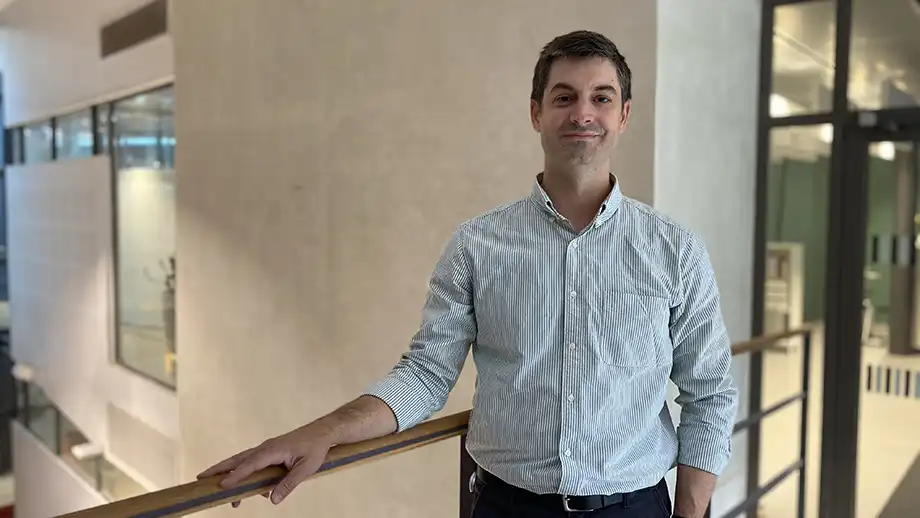
Richard Lee Davis, director of the central makerspace at the KTH Library, which will serve as a gateway to KTH's maker environments. Photo: Sabina Fabrizi
Published Dec 02, 2025
KTH will establish specialised maker environments, experimental workshops, at each school and coordinate them through a central makerspace at the KTH Library. Everything will be ready for the library's reopening in 2027.
“Many students are not yet familiar with these environments. We are now investing in a central hub that is open to all students, as a first point of entry,” says Joakim Lilliesköld, Deputy programme manager for KTH’s change programme Future Education.
A kind of workshop
Several technical universities have maker environments where students and employees can work practically on student projects and their own ideas. These environments are workshops with computers and machines for developing new innovations.
KTH currently has several maker environments, but these are not coordinated and awareness of them among staff, students and especially people from the outside like potential students is low. To improve this, the maker environments will be financed with SEK 2 million per year in 2025 and 2026, with the help of donations, funds from the Basic Education Grant (GRU) and reinvestments from tuition fees.
Integrated into education
Five specialised maker environments will be established at the schools, with staff, booking systems and increased visibility on the web. They will be integrated into the educational programmes and actively used in courses and projects. A project manager has been appointed for each maker environment. All five maker environments will be open to everyone at KTH.
‘We are committed to ensuring that each school develops its environments so that they complement each other and benefit KTH as a whole. The goal is to give students the opportunity to move from theory to practice – not only to design solutions, but to build them and understand the entire system. In a rapidly changing AI-driven landscape, the ability to learn engineering by creating and building real things is becoming more essential than ever,” Lilliesköld says.
A gateway to other maker environments
Richard Lee Davis has been appointed director of the central makerspace at the KTH Library, which will serve as a gateway to KTH's other environments, each specialising in its own field.
“I will build this space from the ground up and work closely with project managers at the schools to create a healthy ecosystem. “We will work hard to make the central makerspace open and inviting to all KTH students and staff,” he says.
Continuing research
Richard Lee Davis, who comes from Stanford where he earned his doctorate in learning in maker environments and his master's in computer science, will also continue his research on these topics at KTH.
“Part of my job is to investigate how to design learning environments like this. We would like to meet other people at KTH who are interested in pursuing educational excellence in maker environments. In building up this network, I believe we have an opportunity to have a big impact on education at KTH, which is very rare,” he says.
Since 2019, KTH Flemingsberg has had a maker environment, now called Spaces. The initiative has so far been run and funded by the Department of Medical Technology and Health Systems. So what has the maker environment meant for teaching and students?
Anders Cajander, Director of Spaces
"For Bachelor's of Science, the intention is that students should be employable and immediately effective in working life. From that perspective, experimental environments are a natural choice, where students can really put their theoretical knowledge into practice and get hands-on experience of what industry expects them to be able to do.
When it comes to master's programmes, it is extremely important to be able to try things out, as far as the programme allows. The interdisciplinary effect that arises can also provide skills that are helpful in research."
What do you think about coordinating maker environments?
"It is excellent if this is done with a central hub that points to specialised, distributed makerspaces integrated into education and research. I believe this will provide a cost-effective solution that also offers academic excellence.
If we only had a central makerspace, I think it would have been difficult to make it relevant to all areas of education at KTH. Spaces existed here before. The fact that it is now being highlighted and receiving financial support is greatly appreciated."
Max Gulda, Master's student
"Actually, this isn't my home environment anymore, but I still come here and hang out. What has been incredibly rewarding for us is the close contact with the doctoral students. There's a lot of sports technology here, and that's not what we study, but this is where different worlds can meet. The doctoral students can come up with an idea about something they want to measure on the body. Then we can come up with the other part – how to do it."
What has Spaces meant to you?
"I probably would have been less engaged in my studies otherwise. You take a lot of courses in a year. Then you have a project course, and that's when you can see what you've learned during the year that you can actually do something with. What employers ask for is your own projects. It's a profession that requires you to stay up to date all the time, which requires a genuine interest. Projects are a very important confirmation of that drive."
Jesper Sjöberg, Master's student
"It has been very beneficial for us students that it is integrated into the programme. It is an ideal place to be if you want to do your own projects, with access to all the machines whenever you want. The researchers have been impressively accommodating; you can talk to someone with 30 years of experience sitting in the same kitchen. It's a huge give and take from both sides, and we've gained a lot of knowledge and opportunities just from sitting there eating lunch. We wouldn't have done our current project if it hadn't been for that."
What has Spaces given you?
"What hasn't it given us? Everything I've gained from KTH can in some way be traced back to makerspace. From a course that took me to the makerspace, or the makerspace that took me to an area of interest or an opportunity. I went from not being interested in programming or electronics when I started to building a prototype by the end of my first year. And I can say without a doubt that both summer jobs I got during my studies are a direct result of what I did in the makerspace."