
City Change
- Monitoring target completion of urban interventions in Stockholm
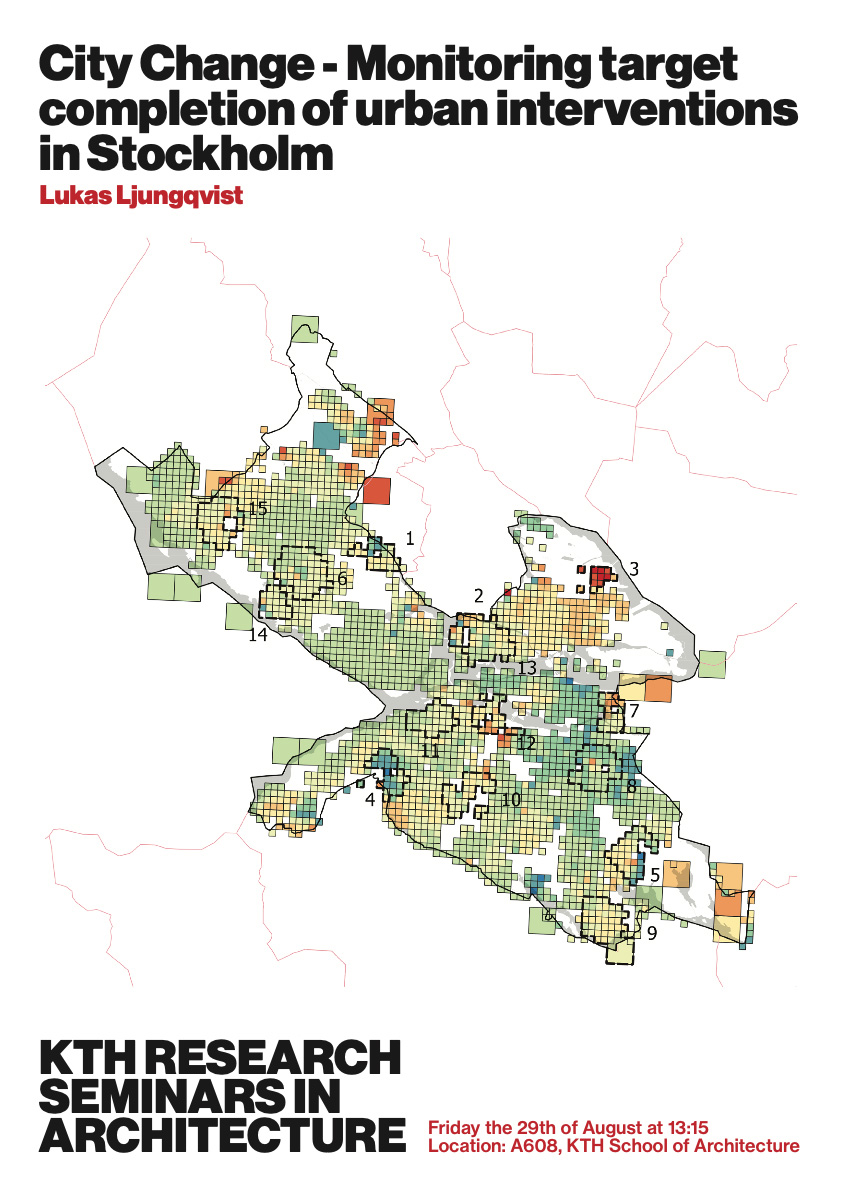
This paper analyses the alignment between urban planning targets and realized projects in Stockholm from 2012 to 2019. Employing both conformance and performance-based evaluation methods, it scrutinizes changes in street networks at both citywide and project-specific levels.
Tid: Fr 2025-08-29 kl 13.15 - 16.00
Plats: Conference Room 6th Floor of the Architecture School Room A608
The opponent for the seminar will be PhD Candidate Seren Dincel
Bios
Seren Dincel is a doctoral candidate in Architectural Design, Technology, and Representation at the KTH School of Architecture. Trained in interior architecture and architectural lighting design, she focuses on the spatial, social, and ecological dimensions of outdoor lighting. Her doctoral project, part of the NorDark consortium funded by NordForsk and the Swedish Energy Agency, investigates how lighting technologies in green spaces influence spatial environments where humans and other species encounter one another, as well as how lighting design knowledge operates in planning processes.
Lukas Ljungqvist (M.Sc. Architecture) is since October 2022 an industrial PhD student at KTH Royal Institute of Technology (School of Architecture) in Applied Urban Design supervised by Professor Ann Legeby (KTH) and Professor Lars Marcus (Chalmers) and Erica Eneqvist (City of Stockholm). His research interest lies in investigating how digital tools and the digital transformation of society is used and can be used in the urban design and planning processes to support a systems perspective and promote a sustainable transition. The thesis has the working title “A revised methodology for strategic urban planning and design, in the digital age, with a just climate transition as a lens”.
Lukas is pursuing the PhD on part time in parallel with his regular occupation in the municipality as an urban planning strategist in the City Planning Administration in the City of Stockholm. Lukas has a background in private practices in urban planning and architecture with a particular interest in climate, energy and sustainability.
Within the City Planning Administration, he has had the position as sustainability strategist focusing on business development, Agenda 2030, innovation and digitalization processes. In this role he was responsible for coordination of the Senseable Stockholm Lab (2019-2024), a research collaboration between KTH, MIT SCL and the Stockholm Chamber of Commerce with a focus on sustainable cities, IoT and AI.