
Redistribution by Urban Design
Centrality, Ecology and Transition in Järvafältet, 1930–2030
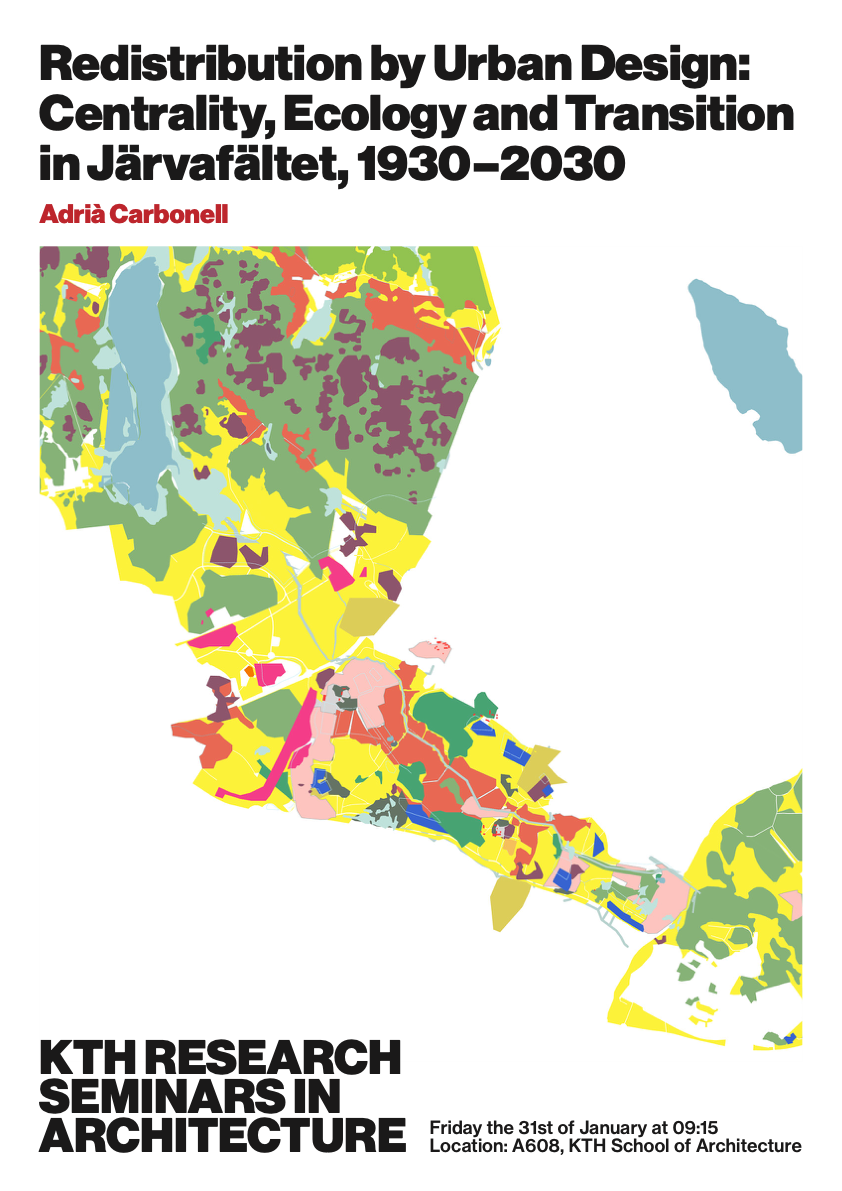
This thesis explores the combined potential of architecture and urbanism to produce transformative forms of socio-economic and socio-ecological redistribution. (From Abstract)
Tid: Fr 2025-01-31 kl 09.15 - 11.15
Plats: A608
Videolänk: https://kth-se.zoom.us/j/67185547897
Abstract
This thesis explores the combined potential of architecture and urbanism to produce transformative forms of socio-economic and socio-ecological redistribution. Situated in a context of planetary urbanisation, growing global inequalities, and climate emergency, it proposes a disciplinary shift that operates within a paradigm of redistribution rather than growth. A transition that moves away from traditional urban development towards the readjustment of existing distribution patterns based on the reallocation of available resources, services, networks, and infrastructures.
The thesis adopts a threefold approach to spatial redistribution: theoretical, historical, and projective. Theoretically, it reframes the economic and political notion of redistribution into a spatial and environmental question. Historically, it examines the forms of redistribution that have guided modernist patterns of urbanisation, with a special focus on the Swedish welfare state period (1930s-1970s), using the northern suburban expansion of Stockholm as a case study. As a projective concept, it understands urban planning and design as redistributive practices invested in the provision of social and ecological welfare. As such, the notion of redistribution is used as a frame and instrument for spatial analysis and as a projective principle for urban design.
This approach is tested in Järvakillen (the Järva Green Wedge), the longest of the ten green wedges infiltrating Stockholm’s metropolitan area. Spanning more than thirty kilometres from the city centre into the northern Uppland territory, the study of Järva offers a compelling case for exploring the interrelations between urban and ecological systems. Importantly, a renewed approach to socio-ecological redistribution should not have a mere reactive rationale. On the contrary, it should embody a transformative potential nested in the projective realm. Ultimately, the thesis argues that territorial design can shift from merely fixing unequal patterns to shaping new systems that anticipate inequalities, thus adding to the redistribution of resources, a predistribution of life forms.
For a copy of the full manuscript contact Adrià Carbonell directly at adria.carbonell-rabassa@arch.kth.se
BIO’s
Adrià Carbonell is an architect and urbanist. He is a lecturer in Architecture and a PhD candidate in Applied Urban Design at KTH Royal Institute of Technology in Stockholm. He has previously taught at KU Leuven, Tallinn Tech, Umeå University and the American University of Sharjah. He is co-founder of the research collaborative Aside, where he combines scholarly work with practise-based research, focusing on the interplay between architecture, territory, politics and the environment. Adrià is co-editor of the anthology Infrastructural Love: Caring for Our Architectural Support Systems (Birkhäuser, 2022). His writings have been widely published in magazines, academic journals and book anthologies (The Journal of Architecture Education, San Rocco, ACE Architecture, City and Environment, ZARCH, Cartha, MONU, Plan, among others).
OPONENT
Paola Viganò is an architect and urbanist. She is a Full Professor in Urban Theory and Urban Design at the EPFL in Lausanne, where she directs the Habitat Research Center and the Laboratory of Urbanism, and at IUAV in Venice. She received the Grand Prix de l’Urbanisme in 2013, the title of Doctor Honoris Causa by the UCLouvain in 2016 in the frame of “Utopia for our Time”, the Flemish Culture Award for Architecture in 2017, and the Golden Medal to the career of the Milano Triennale in 2018. Together with Bernardo Secchi, she founded Studio SBSPV (1990-2014). Since 2015, StudioPaolaViganò works on the ecological and social transition of cities, landscapes and territories designing urban and territorial projects and realizing public spaces in Europe. In 2019, her work was exhibited at the Shenzen Biennale and in 2021 at the Venice Biennale. In 2022, she received the Schelling Prize for Architectural Theory. She has published multiple books and articles. Among the recent ones: The Horizontal Metropolis: The Anthology (Springer, 2022), The Horizontal Metropolis: A Radical Project (Park Books, 2019), Territories of Urbanism: The Project as Knowledge Producer (EPFL Press, 2016), Water and Asphalt: The Project of Isotropy (Park Books, 2016).