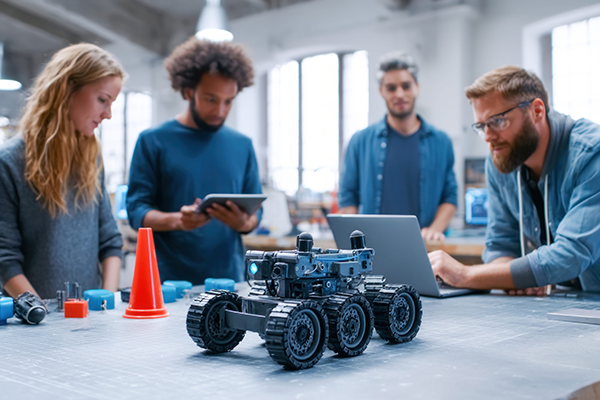
SCI MakerSpace is part of education at the School of Engineering Sciences. Here, hands-on work, prototyping, testing and collaboration are integrated into courses, project courses and other project-based learning activities. SCI MakerSpace also provides opportunities for independent initiatives, degree projects and projects that develop further over time.
SCI MakerSpace throughout your studies
SCI MakerSpace provides an introduction to hands-on and project-based work. Here, you can build, test and develop ideas from an early stage in your education, in an environment where theory meets practice.
As you progress in your studies, SCI MakerSpace can be used in courses where projects, prototyping, testing and experimentation play a greater role. Here, the makerspace provides an environment for developing ways of working where students learn by doing, both individually and together with others.
SCI MakerSpace can also be used for degree projects, independent initiatives and projects that develops outside the regular course structure. This allows ideas to start on a small scale and develop further, from an initial sketch to a finished prototype or a more advanced project.
Projects that continue beyond courses
SCI MakerSpace is not only used in regular teaching. It also provides space for degree projects and independent projects. This makes the makerspace an environment where ideas can continue to develop between courses, grow through collaboration with others and evolve over a longer period of time.
Student-led initiatives
SCI MakerSpace is also a meeting place for student-led organisations and projects. Examples include KTH AI Society, KTH Formula Student, KTH Aero Design, Ägir Sailing Team and the ÆSIR student rocketry association. Having different projects in the same environment makes it easier to share experiences, use equipment, help one another and create a vibrant environment across study programmes and year groups.
From makerspace to research labs
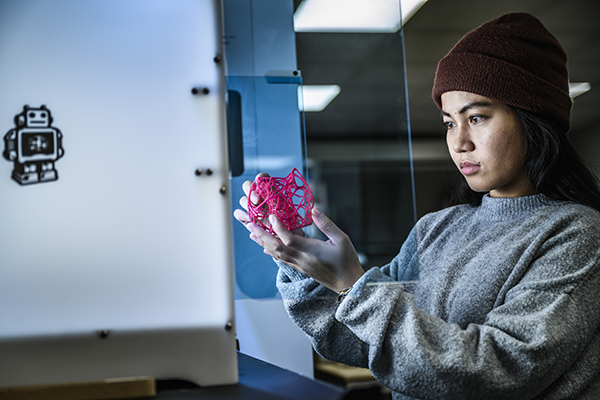
SCI MakerSpace also serves as a link between education and more advanced experimental environments. Here, you can build, 3D-print, measure and test at an early or preparatory stage before moving on to research labs and more specialised equipment.