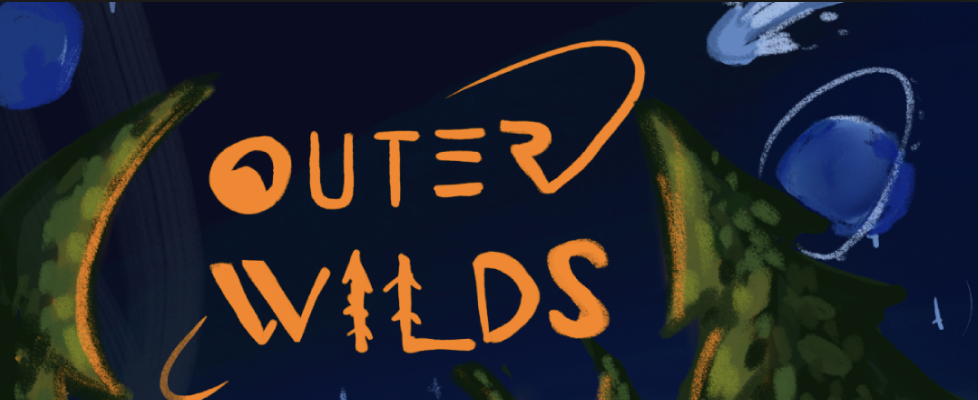
Archaeologies of Space: Learning from the Environments of Outer Wilds
Join us in this interactive workshop with post-doctoral researcher Tijana Rupčić, exploring what we can learn from the environments of the video game Outer Wilds.
The KTH Environmental Humanities Laboratory is excited to host a half-day, interactive workshop led by postdoctoral researcher Tijana Rupčić. The workshop focuses on the acclaimed game Outer Wilds (Mobius Digital, 2019), which is an exploration-based adventure game set in a handcrafted solar system caught in a 22-minute time loop ending with the sun’s supernova. Participants will have the opportunity to play and discuss Outer Wilds, exploring how the game and other digital media use environmental storytelling, and delve into the relationship between environmental humanities and digital media, reflecting on how landscapes, infrastructures, and ecological systems “speak” when used in digital media. This workshop is the second in a series, focusing on how different games shape our understanding of environments.
Attendance at the workshop is free and open to all students, faculty and staff. Registration is limited to 20 people, as we have limited spots to make sure everyone has adequate gaming time. Fika and refreshments provided.
Tijana Rupčić is a Postdoctoral Ragnar Holm Research Fellow at the Royal Institute of Technology (KTH), Sweden. A historian of technology, gamer, and self-described infrastructure detective, she explores how humans build worlds—from power grids and road networks to archives, bureaucracies, and video games.
About the game
Outer Wilds (Mobius Digital, 2019) is an exploration-based adventure game set in a handcrafted solar system caught in a 22-minute time loop ending with the sun’s supernova. Players take on the role of a Hearthian astronaut who investigates the ruins of the ancient Nomai civilization, unravels the mysteries of planetary environments, and gradually pieces together why the universe is collapsing.
The game’s core innovation is environmental storytelling: each planet is a dynamic system that changes during the loop (Brittle Hollow collapsing, the Hourglass Twins shifting sand, the Ash Twin project revealed). Instead of quests or dialogue, the world itself functions as the narrative, requiring players to learn through exploration, observation, and repeated loops. At its heart, Outer Wilds is about curiosity, fragility, and impermanence, inviting players to confront cosmic scale, ecological interdependence, and the inevitability of endings.