
To KTH's start page

Salary review

Joint information from KTH and the relevant unions concerning salary review
Contact

Contact your manager or HR Manager at the school for questions regarding salary review.

Trade unions at KTH

Salary statistics

Salary statistics KTH 202606 - non managers (pdf 48 kB)

Salary statistics KTH 202606 - managers (pdf 38 kB)

Salary statistics BESTA KTH 202606 - non managers (pdf 314 kB) ​​​​​​​

Salary statistics BESTA KTH 202606 - managers (pdf 42 kB) ​​​​​​​

Pay survey

Annual pay survey at KTH (pdf 630 kB) ​​​​​​​

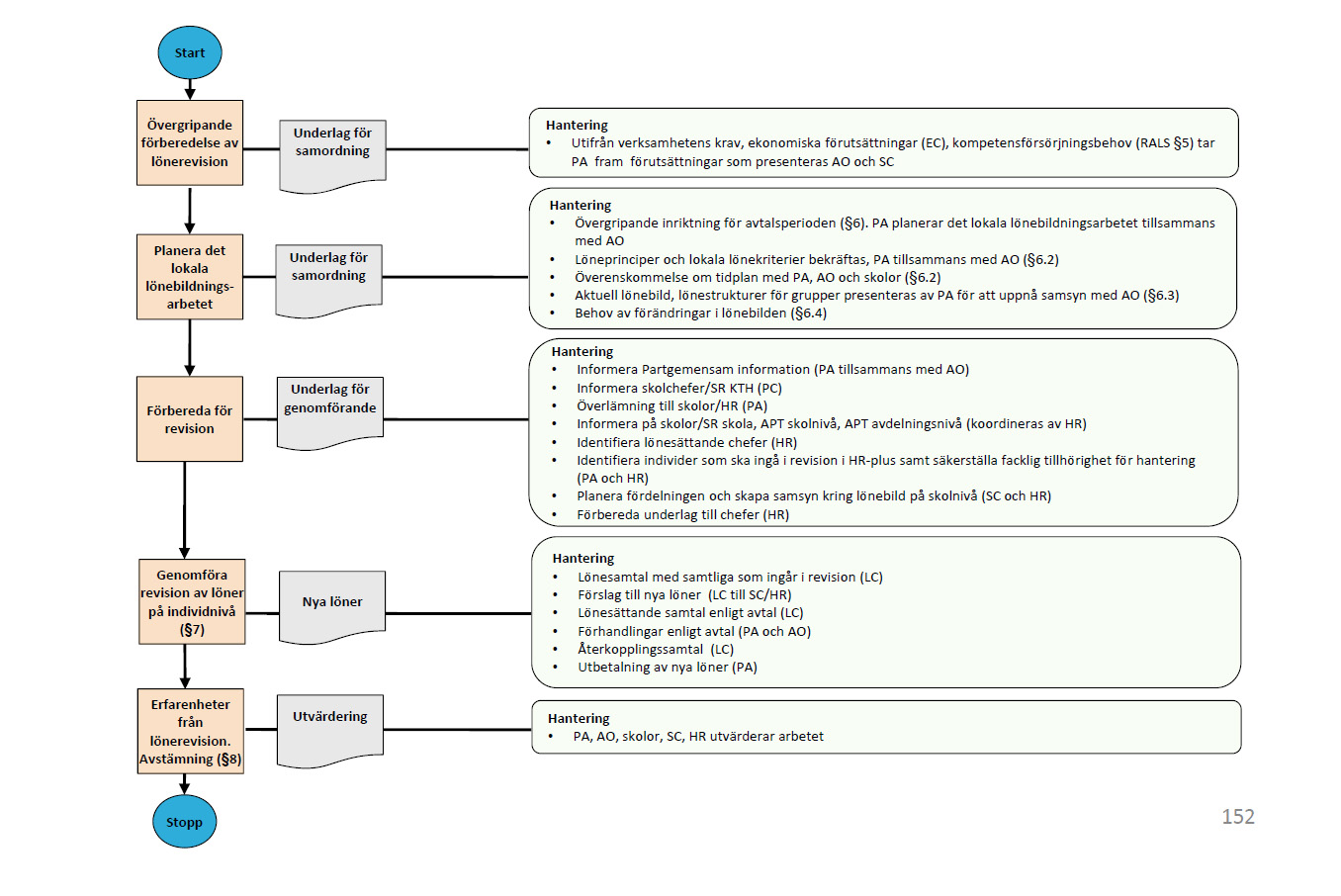
Process modell (Swedish)

Regulations

Guidelines Salary structure (pdf 64 kB)

Instructions concerning salary level criteria (pdf 60 kB) ​​​​​​​

Collective agreement at KTH (in Swedish)

Framework agreement covering salaries at KTH (2025-2027) (pdf 148 kB)

Salary review

Central agreements with Saco-S, OFR/S and Seko regulate salary level setting at KTH.

As an employee at KTH you are entitled to a salary dialogue with your closest manager. The salary dialogue should focus on your work performance during the past salary review year in relation to current salary criteria. During the dialogue, you have the opportunity to explain your work and contributions. It is important that you and your manager are well prepared to ensure a good salary dialogue.

Central agreements regulate salary level setting at KTH. These central agreements also stipulate an annual salary review.

Salary review applies from October 1st.

Preliminary schedule salary review 2026

  • From Mid-August: Information regarding the process of salary review at local workplace/team meetings (ATP), is held before salary dialogue
  • September: Salary dialogue
  • From Mid-October: Negotiations OFR/S (ST) and SEKO
  • From Mid-October - end of October: Salary setting dialogue, members Saco-S
  • November – December: Negotiations Saco-S, disagreements from salary setting dialogue
  • December: Feedback dialogue new salaries: OFR/S (ST), SEKO, non-organized and disagreements
  • 23nd of December: Payment new salaries

What characterizes a good salary dialogue?

Some success factors are important if managers and employees are to feel that the salary dialogue has worked well. Managers must:

  • Have a dialogue in which employees have been able to discuss their work, results and salaries and have been afforded the opportunity to explain their views.

  • Have explained and justified their assessments.

  • Have made ​​it clear how employees can develop and affect their future salary levels.

  • Shown themselves to be open to further dialogue.

Preparations - important prerequisites for a good dialogue

The prerequisite for a good dialogue is that both the manager and employee are well versed about the purpose of the dialogue and have prepared well, which should include a study of the relevant salary criteria and applicable salary statistics.

Employees should be able to participate in departmental information meetings (workplace or equivalent) prior to salary dialogues. At these meetings, information will deal with the approach and content of the dialogues as well as salary criteria for the department. Preparations should focus on what the dialogue will deal with - the employees' duties, achievements and skills linked to operational objectives and needs, KTH salary level setting criteria and the employee's salary. Consequently the focus is on preparing for the proper objective of the salary dialogue, not preparing for negotiations. The most skilled employees should earn a higher salary, not the most skilled negotiators.

Both managers and employees must contribute to the dialogue, characterized by openness and respect. However the manager, as the representative of the employer, bears the greatest responsibility for carrying out the salary dialogue in the best possible manner.

Salary review at KTH - three different kinds of models

For members of Saco-S unions as of September 30 the Salary Review Dialogue is applied and for members of OFR/S (ST at KTH) as of September 30 and members of SEKO as of September 30, the salary dialogue model is applied by using traditional negotiations.

The trade unions at KTH play an important advisory and supporting role for their members throughout the salary review process.

For non-union employees, the employer determines new salary levels after the salary dialogue.

Salary Review Dialogue (Saco-S)

The model for Salary Review Dialogue at KTH involves a salary dialogue – Dialogue 1. During this dialogue, employees have the opportunity to explain their work and contributions. Managers will be able to clearly explain their assessments of individual performance in relation to current salary criteria ​​​​​​​. Subsequently an additional dialogue – Dialogue 2 (the salary review dialogue) is held. The purpose of this dialogue is to agree on a new salary level. Managers communicating and clarifying their reasons for salary determination form a prerequisite for salary levels to function as a policy instrument and for employees to be given the opportunity to develop and thus influence future salary levels. In combination with development dialogues, salary review dialogues provide improved clarity of communications and leadership. If the new salary level is to apply, the manager and employee must sign a written agreement stating this.

If the manager and the employee are not able to agree on a new salary level in their salary review dialogue, the matter is referred to traditional negotiations between the employer and Saco-S. The employee notifies Saco-S KTH (saco-loner@kth.se) and the manager informs the HR Manager at the school (employees at the University Administration the HR Manager at the University Administration). The labour market parties will then review the factors set out above under the headings Salary dialogue/What characterises a good salary review dialogue?

During the negotiations, which takes place at school level, participants will be representatives of Saco-S, KTH Human Resources department and representatives from the relevant school or the University Administration, most often the head of school and the HR Manager at school. An overall discussion about the salary review process at school takes place and then each individual case is taken up and discussed. The content of the feedback to be given by the manager to the employee is formulated jointly.

PILOT TEST of Enhanced Dialogue in the 2026 Salary Review Process – Applies only to Architecture and the Built Environment (ABE school)

In accordance with the RALS 2010-T collective agreement between the Swedish Agency for Government Employers (Arbetsgivarverket) and Saco-S, local parties have the option to apply an enhanced dialogue model between manager and employee in cases where they are unable to agree on a new salary during the salary-setting dialogue (Meeting 2).

Saco-S and employer representatives have jointly decided to pilot this model during the 2026 salary review process at Architecture and the Built Environment (ABE) to evaluate the model.

Enhanced Dialogue (applicable only to members of Saco-S) is used in cases where a manager and an employee have not reached agreement during the salary-setting dialogue. The manager and employee meet once more, now in an enhanced dialogue together with a representative from Saco-S at KTH and an HR representative. The primary objective of the enhanced dialogue is to establish a shared understanding of the salary process and, where necessary, help the manager and the employee engage in a more constructive dialogue as well as clarify any outstanding questions from the first two meetings.

If disagreement regarding the new salary remains after the enhanced dialogue has been conducted, the new salary will be considered determined in accordance with the employer’s proposal.

Practical procedures for enhanced dialogue 2026 - ABE school

If a manager and employee are unable to agree on a new salary during the salary-setting dialogue, this will result in an additional meeting - an enhanced dialogue. The manager provides the form “Non-agreement on new salary.” The employee informs Saco-S at KTH (saco-loner@kth.se), and the manager informs HR at ABE. The employee sends their copy of the form to Saco-S together with a brief and clear explanation of the reason for the disagreement. Any salary claims should be linked to the salary level criteria. The manager submits their copy of the non-agreement form, along with an attachment containing their explanation of the disagreement, to HR at ABE.

The enhanced dialogue between the manager, employee, the ABE school’s HR representative and a representative from Saco-S will take place as soon as possible, but not before the 16th of November in accordance with the preliminary schedule for the salary review. The enhanced dialogue meeting is led by the manager and the employee. Its purpose is to resolve a deadlocked disagreement and establish a shared understanding of the salary review process. The role of the Saco-S representative and the HR representative is, where necessary, to help the manager and employee engage in a more constructive dialogue. The meeting should ensure that the salary-setting dialogue has followed the model agreed upon by the parties and reflects the characteristics of a well-functioning salary-setting process.

Traditional negotiations (OFR/S and SEKO)

This model begins with a salary dialogue. During the dialogue, employees have the opportunity to explain their work and contributions. Managers will be able to clearly explain their assessments of individual performance in relation to current salary criteria ​​​​​​​. After the salary dialogue, the salary level is negotiated between the employer and the trade union.

Successful salary setting requires that the immediate manager, after the negotiations are completed between the employer KTH and OFR/S (ST at KTH) and SEKO respectively, is responsible for making sure the employees are informed of their new salary levels. Employees are informed through feedback dialogue where the result and reasons for their new salary are motivated.

Read more about the different models for salary setting at KTH in the link below:

About different models for salary setting (pdf 149 kB)