Podcast "Fika Chat on the Future of Education" – episode 73
Fika chat on the future of education episode 73 with the guest Erik Wallström from Google Cloud.
How can teachers benefit from NotebookLM, and how do they do so? KTH now has an approved licence for several generative AI tools, including a Google Cloud licence. In this podcast, we get a live demo from Erik Wallström (Google) on how to use NotebookLM, which has been noticed and used by the Future Education programme management.
Status regarding the Google Cloud licence (6 March 2026)
Right now (March), IT is working on setting up the technical infrastructure so KTH groups can access the environment. After that, KTH groups that want to use Google Cloud services will be able to do so if a project code is linked to the user group so that all costs can be billed directly to the group.
Users are responsible for learning how to use Google Cloud services, as there is currently no budget for support at KTH for this.
KTH employees now have access to various generative AI tools (GAI) thanks to procured agreements. Among these, KTH has an agreement for Google Cloud and related products. Work on implementing these is ongoing and will hopefully be in place in March. Questions about this agreement can be directed to
Jonas Svensson (SciLifeLab)
.
The Google NotebookLM tool has been noticed and used many times by the Future Education programme management. During this podcast, we will get a demo of how to use it.
Please note that information about the Google Cloud agreement has yet to be added to the IT support's pages on
KTH’s approved AI services
.
Podcast guest: Erik Wallström
Erik Wallström is an AI Customer Engineer at Google Cloud. He has been invited to fika chat with Joakim Lilliesköld, deputy programme manager for KTH's Future Education change programme, and Marcus Lithander, podcast host and principle coordinator for (P3) Active Student-Centred Learning in the
Principle framework
of the Future Education at KTH.
We will get a demo of the AI tool NotebookLM and answers to the following questions:
NotebookLM is known for sticking to the sources, but can we trust it 100% in an academic environment?
What should teachers avoid uploading to the tool (e.g. unpublished research or student work)?
How does student learning change when they can "interview" their course literature instead of just reading it linearly?
Can we use NotebookLM to generate relevant discussion questions or quiz material based on specific chapters?
How quickly can I, as a teacher, get an overview of 500 pages of new research before a lecture?
Are the AI-generated podcast conversations in NotebookLM a serious complement to the course literature, or just a fun feature?
How can we use the tool to teach students to evaluate sources critically? (E.g. by checking whether the source references actually support the AI's answers).
Feel free to ask questions in the Zoom chat!
Related podcast episodes
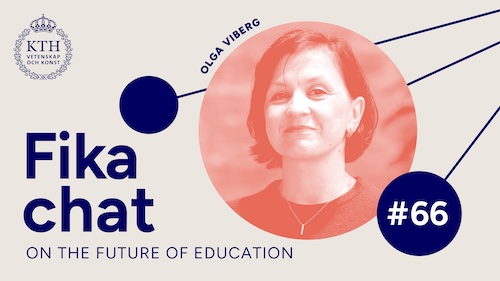
Fika Chat on the Future of Education episode 66 with Olga Viberg. Graphic: KTH.
Fika chat on AI and learning in higher education with Olga Viberg
There is a lot of talk about ChatGPT and other generative AI tools. How have they changed the way students learn at university? Marcus Lithander (Podcast Host) and Joakim Lilliesköld (Deputy Programme Manager of Future Education at KTH) chat over coffee in episode 66 with Olga Viberg (Cluster Coordinator for AI and Learning in Higher Education and a leading researcher in AI in education and learning analytics) about her vision for KTH as an international leader in AI in education, ongoing initiatives and what is happening in Digital Future's research focus period this spring.
Fika chat on Recommendations for AI use in KTH’s teaching with Caroline and Iris
How has the Faculty Council’s recommendation on what teachers should tell students about course-specific AI use been implemented at KTH? Marcus Lithander (podcast host) and Anna Jerbrant (Future Education programme manager) discuss in Swedish with Caroline Bern (E-learning) and Iris Callerholm (KTH Student Union, THS).
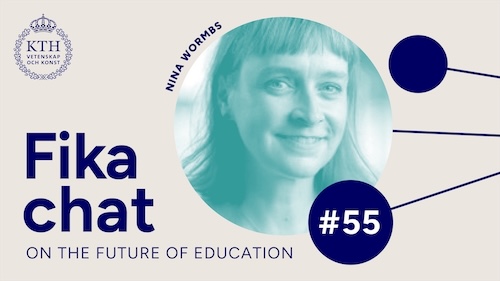
Fika Chat on the Future of Education episode 55 with Nina Wormbs. Graphic by Malin Ringsby.
Fika chat on Clear student information for AI and learning with Nina Wormbs
How should students know if and how they can use AI in a course? The Faculty Council has now produced a joint KTH recommendation on what teachers should tell students about what applies. Vice Dean
Nina Wormbs
reveals the "theft", why the recommendation is so short and talks (in Swedish) to Marcus and Joakim about the development, implementation and effects for teachers and students around AI and learning.
Fika chat on Generative AI and programming with Henrik Kniberg
When today's knowledge in generative AI and programming will be dated asap, how will the role of teachers change? How will teachers learn to ensure that graduates have the ‘right’ skills that industry demands? Johan and Joakim Lilliesköld talk in Swedish to KTH alumnus
Henrik Kniberg (crisp.se)
about practical applications of generative AI and how it will change both education and the need for programmers in the future.
Fika chat on Various perspectives on AI in higher education with Arnold Pears and Avid Fayaz
How are generative AI tools used in courses today at KTH? Until KTH has decided on common guidelines: what general principle can students use to know what is considered ‘cheating’? What can't be said too often in these contexts? Johan and Joakim Lilliesköld talk to Professor
Arnold Pears
and student
Avid Fayaz
, who is a podcaster and active in the
KTH AI Society
.
Fika Chat on the KTH-joint AI project taking off autumn 2024 with Arnold Pears
What can we expect from the first KTH-wide AI project, due to start in autumn 2024 as part of the Future Education initiative? Johan Flid Fridell and Per Fagrell meet Arnold Pears, project manager for
Integration of AI in KTH’s courses and programmes offered
on how KTH can/should use AI in teaching.
Fika chat on how AI is changing education with Arnold Pears
Arnold Pears is Professor of Engineering education research at KTH. His research focuses on understanding the learning experience from a student perspective, both in terms of learning specific engineering concepts and more generally in terms of engineering skills and competences. He joined the latest episode of the podcast to talk about the impact of AI on education and teaching.
If you want to print the transcription file on KTH Play, you can find the transcription function by 1. clicking the icon at the top right of the video view (a text field appears to the left in the video view) and 2. Click on the three dot menu that appears.
If you are looking for more extensive information about a particular episode, they are also found on
All episodes
.
If you want to print the transcription file on KTH Play, you can find the transcription function by 1. clicking the icon at the top right of the video view (a text field appears to the left in the video view) and 2. Click on the three dot menu that appears.
If you are looking for more extensive information about a particular episode, they are also found on
All episodes
.
About the podcast
Marcus Lithander chats over coffee (fika) with guests from or outside KTH about the future of education in general and our change programme "
Future Education at KTH
" in particular.
Post questions live or email beforehand
Since we are podcasting live, you have the opportunity to ask questions and comment during the conversation. You can also email questions beforehand to
framtiden@kth.se
.
Co-create for the podcast
Do you have suggestions for podcast topics? Then you are welcome to contact
framtiden@kth.se
(write "podcast" in the subject line).