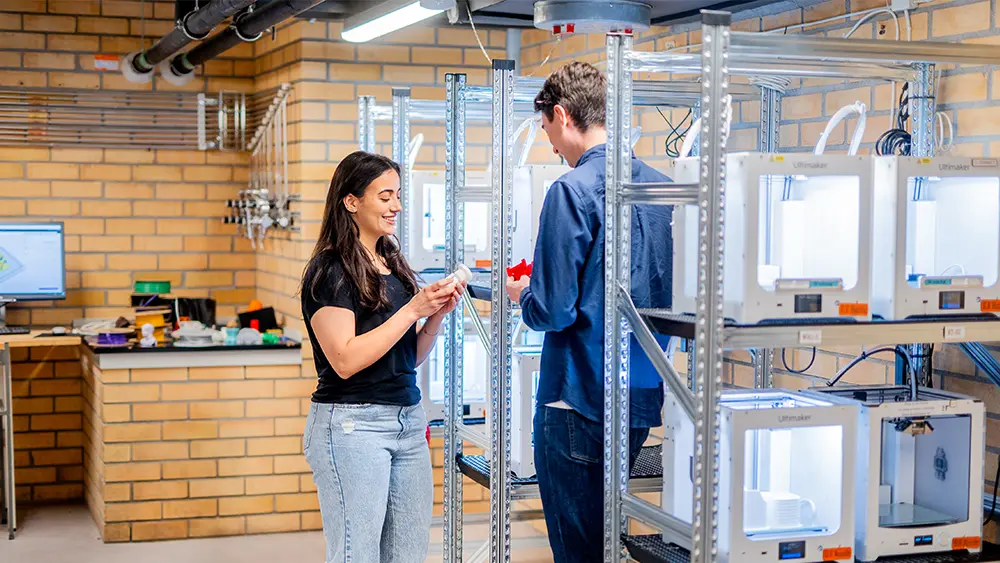
KTH is currently developing makerspaces that support new ways of integrating theory and practice into education. Welcome to a series of seminars during the autumn of 2026 and the spring of 2027, which will explore how experimental learning, makerspaces, AI and pedagogical development can contribute to the engineering education of the future.
KTH is building a network of makerspaces designed to give all students the opportunity to build, prototype and solve real-world problems – throughout their studies. KTH's President Anders Söderholm sees this as a crucial step towards a more future-oriented engineering education.
The seminars are open to all teachers at KTH.
You can join the seminars on Zoom or by physical attendance.
During this hybrid seminar, Pierre Dillenbourg, Pascal Vuilliomenet and Christoph Koch from the Swiss university
EPFL (epfl.ch)
will present how they have developed and integrated makerspaces into its campus and curriculum through the
MAKE network (epfl.ch)
.
KTH's president Anders Söderholm will inaugurate the seminar series and talk about the importance of makerspaces for the future of engineering education at KTH.
The seminar will explore the pedagogical vision for EPFL and how this drove the development and design of the MAKE network, and specifically the
SPOT makerspace (epfl.ch)
. You will hear about how they have transformed their courses to incorporate making and project-based learning, how they utilize the MAKE network, and what impacts this has had on their students' learning.
At the end, we will leave time for questions and discussion.
Register to attend – this seminar is open to all teachers at KTH.
You can join in person or by Zoom (link will be sent out to all who have registered).
As AI challenges research, teaching and administrative practices, and creates potentially transformative advances in scientific fields, the response of universities, notably their defence of the human struggle and its value in an AI-augmented world, will have profound implications for their future relevance and purpose.
This talk addresses a number of issues shaping this discussion and points to considerable opportunities open to institutions willing to act: where AI frees universities to concentrate on what only they can do, and where human judgment becomes more valuable, not less.
Questions we will explore include:
What is the university for when AI can generate information, analyse data and, increasingly, produce new knowledge?
Why do universities find it so easy to start new initiatives, and so hard to stop or redesign anything?
Who owns AI as a strategic question within the university, and is it decided where questions of institutional design are decided?
When AI can produce a result, should universities value the result, the human struggle behind it, or both?
What would it take for universities to organise around new developments, from AI to new learning environments such as makerspaces, rather than simply adding them to existing structures?
The seminar will conclude with an interactive discussion on the future of higher education and the learning environments needed to prepare students for an AI-enabled world.
This seminar is open to all teachers at KTH!
You can join onsite or by Zoom. Register to attend onsite.
Speaker
Ian N. Richardson is a faculty member at Stockholm Business School and specialises in strategy, uncertainty and complexity, and AI transformation.
A former technology media executive, co-founder of the national AI for Executives programme, and regular contributor to Times Higher Education on how universities are responding to AI, he’s known for challenging prevailing narratives with a provocative and entertaining approach to public speaking.
Ian N. RichardsonDirector of Executive Education at Stockholm Business School, Stockholm UniversitySBS Executive Education
Information about upcoming seminars will be published here on an ongoing basis.
Help shape our future seminars! Please feel free to send suggestions for speakers or topics for future seminars on makerspaces to Johan Schuber at
jschuber@kth.se
.