
KTH's President entering the second half
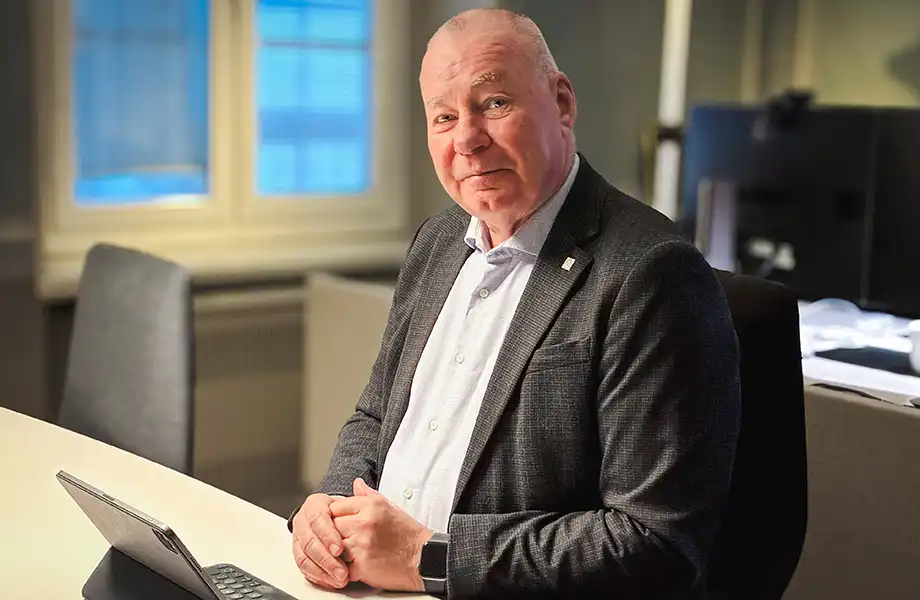
He is a popular speaker and does not mince his words in debates. He believes in delegating responsibility and has great confidence in his 5,000 employees' competence. He has certainly put a face to the selfie. Anders Söderholm has been President of KTH for three years, and 1 December marked the halfway point.
“However, half the job is not done. These three years have gone by very quickly, and we are in the midst of extensive change,” he says, sitting at the conference table in the President's lounge with his tablet in front of him.
He lists processes such as how KTH is forming around the research bill, equipping the EU's new framework programme, and the new range of courses and programmes offered as some of the things he is working on.
When he is not rushing around KTH or attending external meetings, he can be found at his somewhat cluttered desk. He has probably never sat on the sofa or armchairs.
A role model
A lot has happened at KTH and in the world since Anders Söderholm took office. In his inaugural speech, delivered in the library at KTH Campus on 2 December 2022, he spoke about one of his role models: Clarke Kerr, Vice-Chancellor at Berkeley in the 1950s. A vice-chancellor should be a top administrator, a fundraiser and a friend to the students, as well as someone who enjoys long dinners among other things.
"As President, however, you are part of a team, not a lone leader," Söderholm said at the time, adding that teamwork is a way of working, not a trait.
Has it turned out as you intended?
“Yes, I would say so. We have rebuilt parts of the management structure, making the university management smaller while ensuring clearer areas of responsibility. Responsibility and influence go hand in hand and are best confirmed through dialogue. This is clearly evident in our faculty boards, for example.
I think we are moving away from overly detailed guidelines and towards trust and confidence in good judgement – after all, we all just want to do a good job.”
You are an economist, not an engineer – has that played a role?
“No, I don't think so. I have brought with me my experiences as an academic leader. My knowledge of economics has been useful, which is an unintended side effect given the economic turmoil we have been through and are still experiencing to some extent. “
The fact that management quickly recognised what was happening and the causes of the crisis made it easier to deal with, although it was neither easy nor painless, according to Anders Söderholm.
However, like the campus move, this work has driven changes that I believe will ultimately benefit KTH and our development.
What are your thoughts on the future of the economy?
“If we don't experience another shock in the form of sharply increased rents or high inflation, and with better control systems for the economy, things are looking good. And the effects of the campus move will be even more noticeable when all the leases expire.”
You have been very visible in the debate, proposing a new rental model for Akademiska Hus and opening up for cooperation with China on sustainable energy, among other things.
“Yes, that's part of the job.”
Upcoming debates may include the STEM funds that disappeared, how best to finance research infrastructure, and how Swedish universities can cooperate more rather than compete.
Long list
In a year and a half, you will have to decide whether you want to continue after 2028, when your first term expires. But what do you see as the major issues going forward?
Anders Söderholm has a long list:
“Creating security and optimism about the future in the internal culture, continuing to develop collegiality and the range of courses on offer, completing the construction of the new VS into an effective bureaucracy that is close to and beneficial to the core business. Nor should we conduct investigations that we do not intend to put into practice. This is also part of our promise to taxpayers. AI as part of research, education and administration is also on the list.”
He adds that internationalisation issues and geonavigation are moving higher up the agenda as a result of the global situation.
“It will be a strategic sleeper if I should guess.”
People sometimes talk about the 'garden gnome syndrome' – the idea that everyone wants the headmaster or top dog to be involved in everything, regardless of the subject matter or impact. What do you think about that?
“Personally, I think it's great, and I'm happy to play my part – I try to be generous with my time, even though it can sometimes be difficult to find it.”
Taking a selfie with you and alongside an institution, researcher or external visitor, has become something of a trademark for you.
“Yes, perhaps it's a little strange, considering that I'm not really a social butterfly. But I simply enjoy being at the university,” Söderholm says.
Text: Jill Klackenberg (
jillk@kth.se
)
Photo: Tora Zeijlon (
toraz@kth.se
)