
Summer greetings from the school management

EECS is putting an eventful spring with significant changes behind it. This is evident when the members of the school management look in the rear-view mirror and reflect on the past six months based on their respective roles.
Joakim Jaldén, Head of School:

I knew that there would be a lot to learn in a short time when I took on the assignment as the new Head of School for EECS. It is a privilege to lead an organization with so much commitment, competence and talent, but at the same time difficult to prepare for what you do not yet know or can. Getting to know the rest of the school management and finding forms for our collaboration has been fun. I would also like to take this opportunity to thank for the support that many colleagues and friends have shown. It has given me a lot of energy and helped me keep the momentum up. Although I am now looking forward to the holiday rest, I am very happy that I took on the challenge.
Making good decisions and at the same time getting all the strong, sometimes scattered wills that exist and should exist at a university is of course challenging. At times, it can feel like positive change is happening too slowly, especially when you're new to your role and eager to develop and improve. When we look back at the spring, however, it becomes clear that the changes and improvements are there.
We have landed in the new organisation with departments responsible for both research and education, a model that I believe in and for which we have last year's school management to thank. I am particularly pleased that we have also taken a big step towards more operational support in that the school's economists have joined the school office and can link arms with the management coordinators who already work closely with the heads of department and faculty at our departments. When complementary competencies work closely together, we can more easily achieve the goals.
There are many examples of EECS's strength. Over the past four years, in competition with other universities in Sweden and Europe, we have increased our external funding by as much as 40 per cent. We have taken on many important roles in the work with the significant excellence cluster applications that have been submitted. Our training programmes and courses are of a consistently very high quality. However, it costs to maintain such a high level, which is why I wish you all a holiday with time for recovery and the opportunity to gather strength for the autumn.
Markus Hidell, Deputy Head of School and Head of Undergraduate Education:
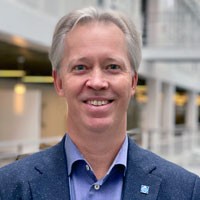
When we sum up the spring term and the academic year, it is very pleasing to note that the school's teaching staff and education office deliver EECS's extensive education portfolio with great commitment and high quality. This is particularly impressive considering that we have also carried out a major reorganisation and restructured the school's more than 500 courses to our new departments. On top of this, we have initiated an unusually large number of degree projects during the spring semester and staffed over 900 degree second cycle projects - an extensive work effort that has been organized in a very good way.
I would also like to highlight the excellent development work that has been carried out to reshape the school's master's programmes in the field of communication and distributed systems. The establishment of new programmes is a painstaking process at KTH with many people involved and therefore always an extensive task with a challenging schedule. Thanks to the working group's strong drive, the president of KTH has nevertheless been able to decide on the establishment of two new master's programmes at EECS just in time for the summer. These will replace three of our current ones starting in the autumn of 2027. I look forward with excitement to the admission round that starts a bit into the autumn later this year.
Joakim Lilliesköld, Deputy Head of School with a focus on change management:
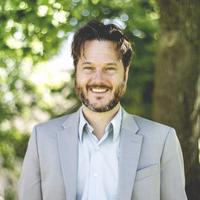
In many ways, spring has been about change, which is close to my assignment. It's rarely a straight journey, but when I look back on the semester, it's clear that we've moved in the right direction.
The new organization is settling, and Marianne and others have made a huge effort to get everything needed in place. As part of the reorganisation, we carried out a kick-off for heads of department, deputy heads of department and management coordinators, with both skill development efforts and the start-up of a head of department programme. The program aims to strengthen the school's leadership and create a community between our managers – which was also one of the stated goals of the reorganization.
An increasingly pervasive question in my work is how AI affects us. The most obvious are the effects on education, where several employees are already involved in developing KTH's way of working. The investment in Makerspace points in the right direction: when students design and build real things, AI becomes an engineering tool.
But AI can have at least as great an impact on our research – not only on what we research, but also on how we do research and who receives funding in the future. We are already hearing from funders and journals that it is not only the number of manuscripts and applications that is increasing, but also the quality. The administration is also facing major changes. Here we need to lift our gaze, from efficiency in our own everyday life to what technology means for the activities both at the school as a whole and at our departments. We also need to experiment more and share best practise, so that we shape the development rather than just adapting to it.
Lina Bertling Tjernberg, Deputy Head of School with a focus on the conditions and impact of research:

The spring semester has been both intense and inspiring. For my part, the year began with a leadership training that provided new perspectives on leadership, cooperation and self-awareness. These have been valuable in my work and not least in the collaboration within the school management.
An important part of my assignment is to strengthen the conditions for research. During the year, I have participated as an expert in an ERC Advanced Grant panel, a learning experience that will be valuable for how the school's researchers can be supported in the work with competitive applications. Together with the Head of School, I have also continued to visit the school's research environments and research infrastructures. During the year, we have carried out ten visits, from newly established environments on KTH Campus to several of the school's research infrastructures. These meetings are always a highlight and remind me of the breadth, quality and creativity that exists within EECS.
Another highlight is arranging and creating the program for EECS Research & Impact Day. The event begins with a poster exhibition and lunch, where especially this year the ten research projects Small and Visionary Projects will be presented. We start with two external speakers and focus on AI and especially we have a panel this year focusing on life science research where an ERC project will be presented. I hope to see many of you there!
After the summer, work will continue as usual, but I would also like to mention that I plan to take a sabbatical at Stanford University from September 2026 and focus more on research for a period.
Henrik Artman, Deputy Head of School with a focus on faculty renewal:
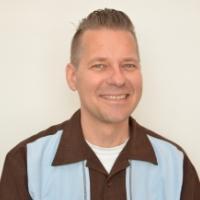
Recruitment of faculty positions takes time, and the spring has been hectic with many interviews. To date, we have landed seven positions, and two more are soon ready. There are two senior lectureships and associate lectureships. It is particularly pleasing that five of the nine positions have gone to women. Gender equality work is progressing slowly but progressing.
The competition has been very high and we are pleased that the school attracts so many strong candidates. Two more associate lectureships will probably be completed in the autumn, which is why we can look forward to many new faces at the school. During the spring, we have also been able to promote six new professors and one senior lecturer. It is a privilege to be part of the interviews and listen to all the successful people who have grand plans and maxed out projects ahead of them.
In addition to this, we have simplified the administration with half-time evaluations of associate lectureships, and this also shows that we have been able to recruit successfully for many years. I have also been involved in the working group for the implementation and further investigation of proposals for the career inquiry. Although it is a challenge to reconcile everyone's thoughts, I think we have done a solid job of reviewing the appointment procedure. The working group's report is on refferal and the work will continue in the autumn.
Marianne Lundin, Acting Head of administration:
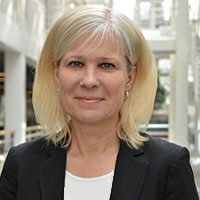
The year took off with a flying start, to say the least, and it has been intensive work to get everything in place for the new department organization at the school. A large part of the initial work as acting head of administration has been to get the necessary decisions in place, establish organisation codes, allocation to accounts, course ownership, staff lists, appointments, system permissions of various kinds for the new heads of department and much else that needed to be addressed.
At the same time, the work of creating well-functioning operational teams at the school's departments has continued. In this context, it is gratifying that the financial support group has been part of the EECS School Office since April. This facilitates the collaboration needed to build a robust organization for operational support.
In parallel with other tasks, the continued work on the development of the school administration, with requirements for efficiency improvements and cost-cutting measures, has taken its toll. I would like to take this opportunity to thank all employees at the school office for their ability to adapt to the current restrictions regarding the refilling of positions. Despite significant reductions in the number of staff, at the same time as the school is growing, we have continued to deliver with high quality thanks to very good work efforts.
It has been great fun to take on a more pronounced role in the school management, and I am grateful for the very good cooperation that prevails within both the school management and the management council, the faculty board and my management team with the school office's group managers.
Lars Jonsson, Director of third-cycle education:
At EECS, we have about 450 active third-cycle students, which makes the school's third-cycle education one of the largest in Sweden. We have four excellent programme directors, and we are three who have shared the responsibility as (deputy/main) director of third-cycle education together with all of you supervisors and third-cycle students. It is a great privilege to work together to further develop our third-cycle education. I would like to take this opportunity to extend special thanks to György Dán, who is completing his mandate, for all his good ideas and important initiatives.
A source of joy for the summer is that 2026 looks set to be a new record year for the number of graduated third-cyle students, with about 60 assigned TRITA numbers. Another is our new AI guide, which is now available on EECS's website for third-cycle education. Other ongoing and important initiatives include a work environment investigation for third-cycle students and the work to transform thirs-cycle programs into subjects. Finally, I would like to mention the third-cycle student retreat, led by Sarunas Girdzijauskas, which has recently been conducted with over 70 participants.