Strategic direction for KTH’s educational offering
The project involves proposing a strategic direction for how KTH's educational offering should be developed, with the aim of facilitating the work of defining more detailed goals and specific positions for the schools' development work in each reform agenda.

Project context
In KTH's current chain of governance, the Vision and overall goals for KTH provide a basis for a three-year rolling operational plan. The reform agendas of the management and the operations units lead to commitments, assignments and measures in the ongoing operations. "Reform agenda" is interpreted here as what we need to do in 3-4 years' time to achieve our goals.
A general problem in all operations is to ensure the mapping between the overall goals and vision and the concrete measures that are planned; often a level of concretisation lacks between them. Very often there are also other strategic principles that should be integrated into the planning work. At the next operational level, the work can then partly become difficult to manage (even ineffective), and partly the situation can lead to a lack of organizational convergence between the parts - they do not form a whole.
KTH's educational offering is an area where such a holistic perspective is of utmost importance, in addition to the fact that the educational offering must be dynamic to meet future challenges and an increasingly high speed of change. As a starting point, a strategic direction should include the characteristics of and the relationship between different types of higer education qualifications.
Purpose (outcome)
The project aims to define a strategic direction and a decision-making basis for KTH's educational offerings, which will facilitate the work of defining more detailed goals and specific positions for the schools' development work in the respective reform agenda, by:
- strengthen the connection to KTH's overall goals;
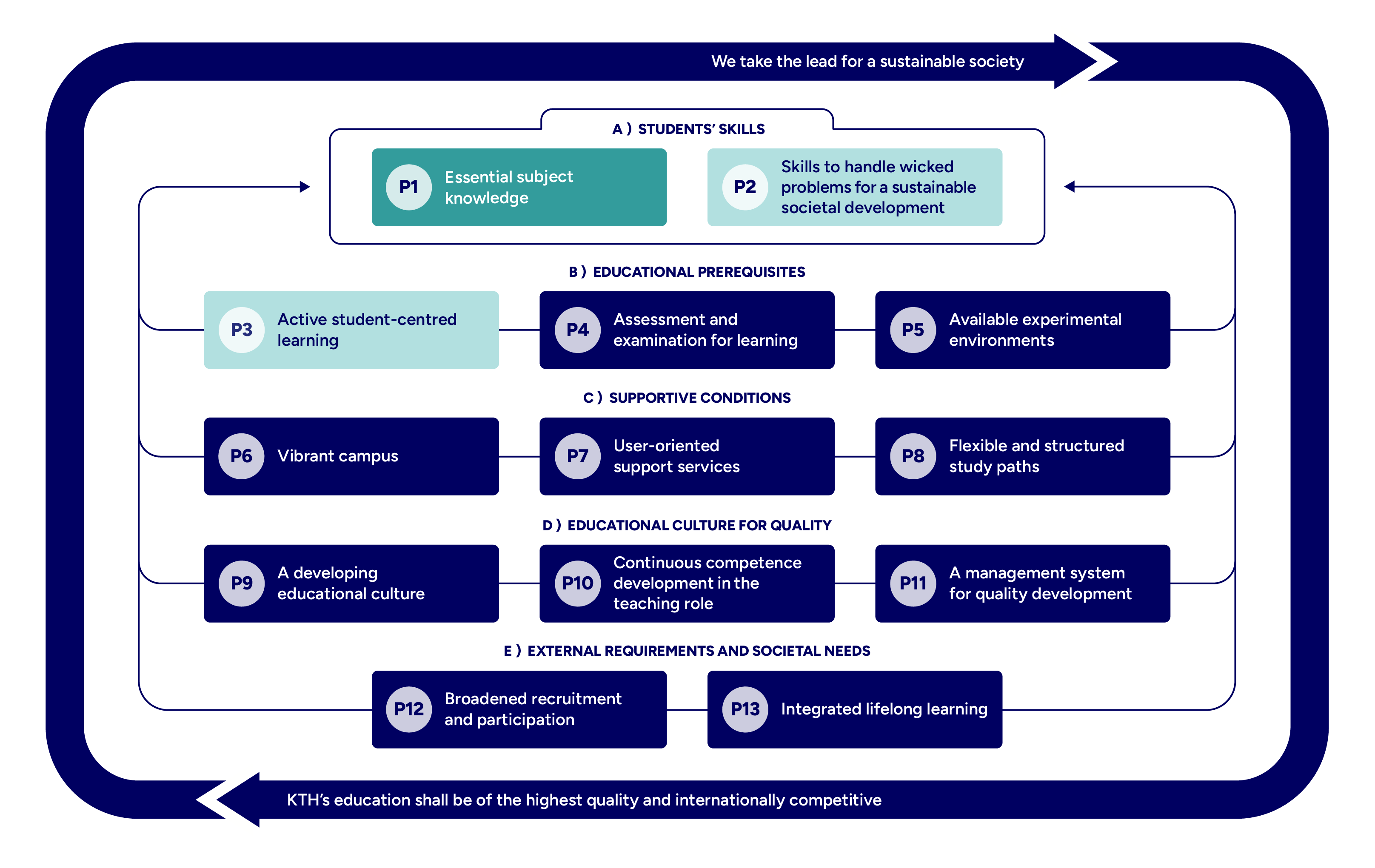
- clarify the strategic direction in relation to the Principles of the Future Education programme.
Project results (output)
- Inventory of previous change initiatives within the educational offering (lessons learnt)
- Proposal for strategic direction for the future development of KTH's educational offering in the form of a presentation, anchored with all schools and other relevant stakeholders.
- (if the project is successful:) Decision basis (with management of the decision process) for the President's decision for future implementation.
Time plan
Start date: 2023-09-01
End date: 2024-04-10
Project documentation
If you have a KTH ID, you can read the documents when logged in:
- Project initiation document: Projektdirektiv_FrU23_2326-KTH_Strat-Inriktning-UtbUtbud.pdf (Swedish)
- Poster: Poster_FrU24ht_2326-KTH_Strat-Inriktning-UtbUtbud.pdf (Swedish)
Results
- Inventory: Resultat_2326-KTH_Inventering-ansatser UtbUtbud (231031).pdf (Swedish)
- Proposal for strategic direction: Resultat_2324-KTH_Strategisk-Inriktning-UtbUtbud.pdf (Swedish)
- Decision: Resultat_2326-KTH_Beslut (V-2024-0331).pdf (Swedish)