
Integration of AI in KTH’s courses and programmes offered
This KTH-wide project involves creating a platform for the exchange of ideas and pedagogical development within the teaching staff and a pilot-tested pedagogical guidance on how AI can/should/will be integrated as subject content in teaching at KTH over the coming years.


Project context
In a world of generative AI, it is easy to focus on cheating in examinations and assessments in educational contexts. But that is a bit too narrow a perspective. The speed of AI development in the world is fast and accelerating, both because AI itself is building its capabilities and since the fields of application, especially in technology, are constantly expanding. Society's demand for professionals with AI skills is therefore increasing rapidly. KTH needs to foster a broader dialogue and establish a strategic direction for how AI-related content can be integrated in a planned and strategic manner into education at KTH.
How can KTH ensure that students at first-, second- and third-cycle levels gain relevant and sharp AI skills from their education?
In parallel with this project, there are several AI-related projects within the Future Education programme, and KTH is also working through the Ethics Committee of the Faculty Council on "AI and Learning".
Purpose (outcome)
The aim is for KTH to be at the forefront of integrating AI competencies into education, particularly in response to the future job market’s demand for engineers with AI training. The desired project outcome is that KTH has committed ambassadors and change leaders who, with relevant and supporting tools, can drive the continued integration of AI in teaching across all KTH schools. This will lay the foundation for integrating AI as subject content into KTH’s curricula and learning outcomes.
Project results (output)
-
A platform for idea exchange and pedagogical development among the faculty, leading to course and program changes that incorporate AI skills within relevant subject areas.
-
A pedagogical guide for how AI should/can/ought to be included in teaching at KTH. Since the project will provide guiding principles, the project’s processes will be tested within 2–3 courses per school, at first-, second- and third-cycle levels.
Time plan
Start date: 2024-09-01
End date: 2025-12-31
Project documentation
If you have a KTH ID, you can read the latest project documents on OneDrive when logged in:
- Poster: Poster_FrU25ht_2401-KTH_AI_251201.pdf (Swedish)
- Poster: Poster_FrU25_2401-KTH_AI_250520.pdf (English)
- Project initiation document: Projektdirektiv_FrU24_2401-KTH_AI-integrering_241001.pdf (Swedish)
Results
- Contacting and coordinating the other AI projects within the Future Education programme. Special mention should be made of Olle Bälter and colleagues at EECS, Åsa Karin Engstrand ITM and Eva Liedholm Johnson ABE.
- Direct contact with KTH's schools for dissemination of knowledge, with seminars on AI and the content of our education, at school boards, teacher days, etc.
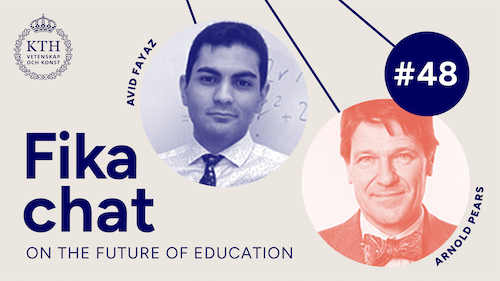
- Wider dissemination via several Fika chat podcasts and joint sessions at Storträffen in spring 2025 with Åsa Karin Engstrand on AI and ethics, with exercises and discussions.
- Application through participation in and collaboration with several degree projects that address the issue in 2025.
- Guide: Generative AI
The project is continuing at the Department of Learning (without funding from the Future Education programme). Future work includes the development of a new higher education teaching course, 3hp, Generative AI in University Teaching and Learning, Spring 2026, as well as targeted initiatives in prioritised areas for KTH's schools.