
Strategic direction for Learning environments
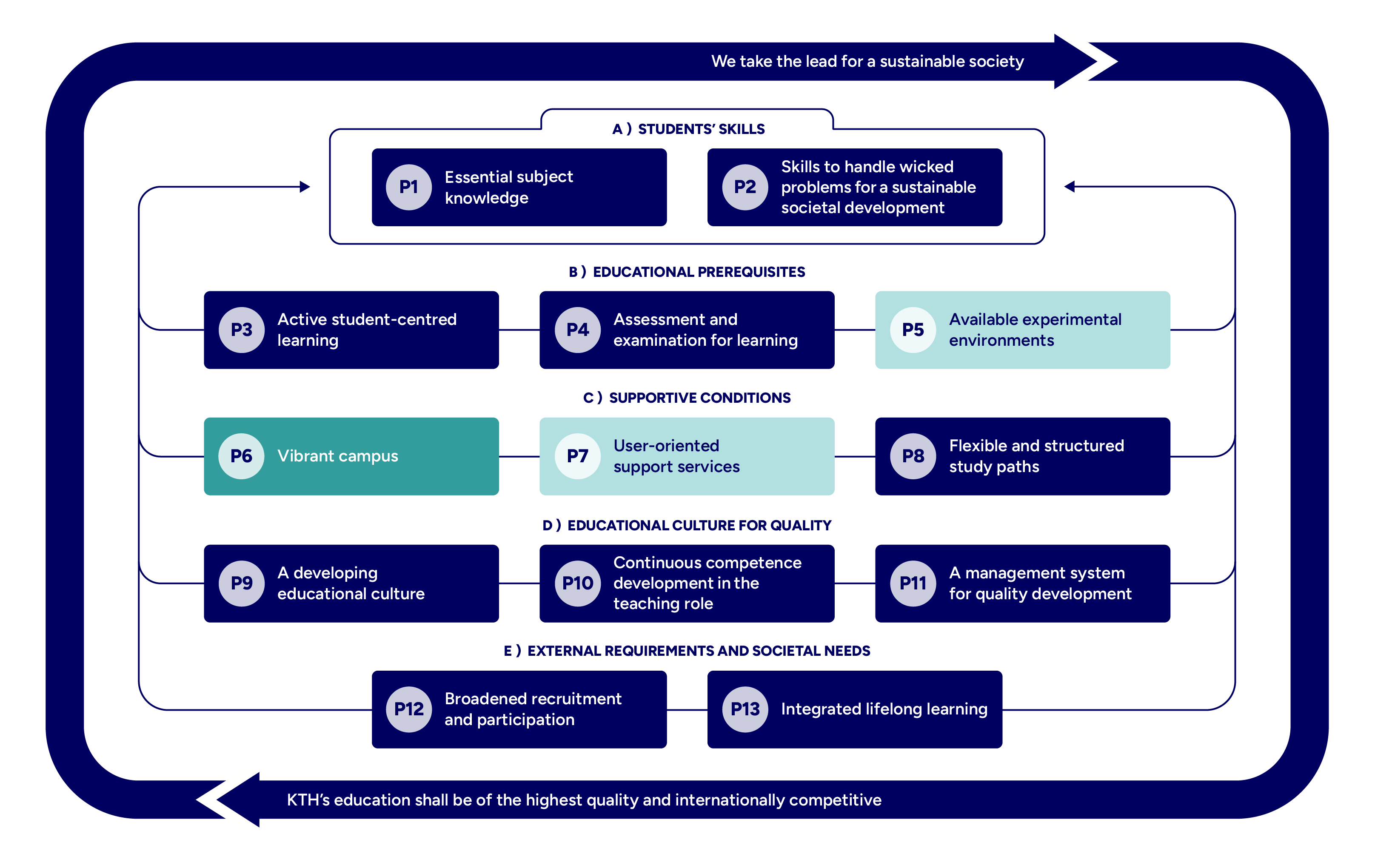
The project involves proposing a strategic direction for how KTH's learning environments will/can/ought to be developed and equipped in line with KTH's strategies and goals as well as parallel ongoing development projects.

Project context
Learning environments consist of the digital and physical environments that our students encounter during their education – both during teaching, learning and examination. The function of learning environments is both social and pedagogical. Are there suitable premises for teaching – given that teaching methods today are developing far beyond traditional lectures and exercises? Are there enough computer labs for digital examination – which is often a prerequisite for continuous examination, which in turn affects student completion? Are there sufficiently high-quality study places and other infrastructure required for students to experience that the Valhallavägen campus is both attractive and relevant? Adapting and dimensioning our learning environments is in practice a so-called wicked problem. There are no simple (standard) solutions, many parameters have an impact, and the parameters have many and complex dependencies between each other. At the same time, the costs of premises are increasing at a much higher rate than the compensation does.
At the end of 2023, the University Board decided on the so-called "campus relocation"; that the activities at KTH would be concentrated on three campuses. The decision meant that all KTH students from both Kista and Södertälje would be moved to the KTH Campus at Valhallavägen – except for the foundation year programme from Södertälje which would be moved to Flemingsberg. The relocated education programmes, in addition to increased admission volumes, actualised the wicked problem described above.
The programme directive for the "campus relocation" project thus received an additional decision in March 2024 (decision on additional assignments to the programme directive for campus relocations, V-2024-0084 KS code 2.2) where a working group was tasked with developing proposals, with clear prioritisation, for how KTH's common learning environments shall /should/may be developed and equipped in harmony with parallel ongoing development projects. The Future Education programme was tasked with planning and facilitating a learning environment boarding school in mid-August 2024. The final report was submitted on 2024-09-15 and after the management group on 6 November, Future Education was also tasked with developing an anchored strategic decision for KTH's learning environments.
Purpose (outcome)
The project aims to define a strategic direction and a decision base for KTH's future management of our learning environments so that:
- The premises become flexible, reliable and enable different forms of interaction
- A student can come to the Campus at any time of the day and find a study place
- There will be a balance in the number of study places and teaching premises for interaction
- All students have access to experimental learning environments
- The possibility for teachers to book premises according to their teaching design increases.
Project results (output)
- Inventory of challenge areaswithin learning environments (with tentative quantification of problem size for certain challenges) and a proposal for strategic direction for the future management of learning environments at KTH in the form of a presentation, anchored with all schools and other relevant stakeholders;
- (if the project is successful:) Decision basis (with management of the decision process) for the President's decision on future implementation.
Time plan
Start date: 2024-08-15
End date: 2025-05-27
Project documentation
If you have a KTH ID, you can read the documents when logged in:
- Project initiation document: Projektdirektiv_FrU24_2410-KTH_Strat-Inriktning-Lärmiljöer_AJerbrant.pdf (Swedish)
- Poster: Poster_FrU25ht_2410-KTH_Strat-Inriktning-Lärmiljöer_AJerbrant.pdf (Swedish)
Results
- Inventory and proposal for strategic direction: Resultat_2410-KTH_Strat riktning Lärmiljoer.pdf
- Decision: Resultat_2410-KTH_Beslut (HS-2025-1323).pdf (Swedish)