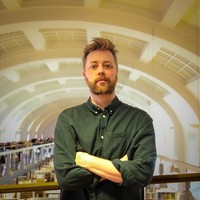
Fika chat on AI, cognitive laziness and study techniques with Emil Wallgren and Marcus Lithander
Podcast "Fika Chat on the Future of Education" – episode 83
How does AI affect our learning? In his research project for the Future Education programme, Marcus Lithander has examined 10 studies on how AI affects our learning. For each study, the project team has drawn up recommendations on how students should use AI to learn over time. Marcus in conversation with Emil Wallgren (THS) and Anna Jerbrant, programme manager for the Future Education change programme and, today, also the main podcast host.
You can also check out the recently published page
Theme: AI in learning and teaching at KTH
, which includes links to the project websites for the AI projects within 'Future Education at KTH’ and the SCI School’s AI page.
Podcast guests: Emil Wallgren (THS) and Marcus Lithander
In today’s podcast episode, Marcus has stepped out of his role as podcast host. He is taking part in his capacity as a researcher in cognitive psychology and project manager for one of this year’s projects within ‘Future Education at KTH’. Instead, it is Anna Jerbrant who is discussing the topic with Marcus and with Emil Wallgren, Head of Educational Affairs at the KTH Student Union (THS).
How does AI affect our learning? In his research project for the Future Education programme, Marcus Lithander has examined 10 studies on how AI affects our learning. For each study, the project team has drawn up recommendations on how students should use AI to learn over time.
Related Fika chat episodes
‘Related episodes’ refers to previous episodes that, for example, relate to the topic or feature one or more of the guests appearing in this episode.
Fika chat on digital game-based learning
What does the research say about digital game-based learning (DGBL)? How can AI-driven personalisation, feedback and assessment be integrated into the game to support learning? And how do adults view, benefit from and sometimes oppose game-based methods in higher education, workplace training and lifelong learning? Professor Bruce M. McLaren and doctoral student Elias Hedling discuss what the research says about game-based learning with Joakim Lilliesköld, deputy programme director for the Future Education programme, and Marcus Lithander, host of the Fika chat podcast. Marcus holds a PhD in cognitive psychology.
Bruce M. McLaren is a Professor at Carnegie Mellon University, head of the McLearn Lab, and past President of the International Artificial Intelligence in Education Society (2017-2019). McLaren is passionate about how technology can support education and has dedicated his work and research to projects that explore how students can learn with digital learning games (also called educational games), intelligent tutoring systems, e-learning principles, and collaborative learning.
Elias Hedling is a newly enrolled doctoral student at the Department of Media Technology and Interaction Design within the School of Electrical Engineering and Computer Science (EECS). He is involved in the READ project, which focuses on improving children’s reading skills using human-centered AI. The overall idea is to develop AI-based reading tutors where children read aloud and receive personalised feedback, while teachers get insights into their progress. More generally, Elias is interested in, and have worked previously on problems relating to, how AI systems interpret and use information, and how that affects the way they interact with people.
Fika chat on the generative AI-tool NotebookLM with Erik Wallström
Erik Wallström is an AI Customer Engineer at Google Cloud. He has been invited to fika chat and show how can teachers benefit from NotebookLM with Joakim Lilliesköld, deputy programme manager for KTH's Future Education change programme, and Marcus Lithander, podcast host and principle coordinator for (P3) Active Student-Centred Learning in the Principle framework of the Future Education at KTH.
Status regarding the Google Cloud licence (6 March 2026)
Right now (March), IT is working on setting up the technical infrastructure so KTH groups can access the environment. After that, KTH groups that want to use Google Cloud services will be able to do so if a project code is linked to the user group so that all costs can be billed directly to the group. Users are responsible for learning how to use Google Cloud services, as there is currently no budget for support at KTH for this.
Please note that information about the Google Cloud agreement has yet to be added to the IT support's pages on
KTH’s approved AI services
.
Fika Chat on the Future of Education episode 72 with Sofia Knutz and Lena Salomonson
Fika chat on study counselling and study techniques with Sofia Knutz and Lena Salomonson
How can KTH support students with their study skills? Marcus Lithander is commissioned to develop a KTH-wide study technique concept with integrated study counselling support. In this episode, he talks to Sofia Knutz and Lena Salomonson (University Administration, VS), who lead the project "Study counselling and Funka".
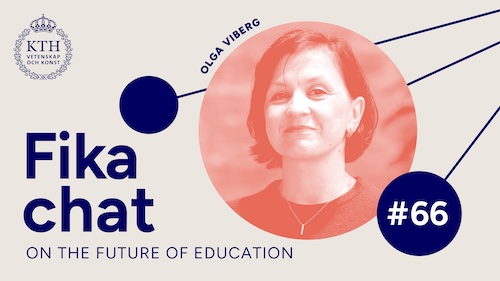
Fika Chat on the Future of Education episode 66 with Olga Viberg. Graphic: KTH.
Fika chat on AI and learning in higher education with Olga Viberg
There is a lot of talk about ChatGPT and other generative AI tools. How have they changed the way students learn at university? Marcus Lithander (Podcast Host) and Joakim Lilliesköld (Deputy Programme Manager of Future Education at KTH) chat over coffee in episode 66 with Olga Viberg (Cluster Coordinator for AI and Learning in Higher Education and a leading researcher in AI in education and learning analytics) about her vision for KTH as an international leader in AI in education, ongoing initiatives and what is happening in Digital Future's research focus period this spring.
Fika chat on Recommendations for AI use in KTH’s teaching with Caroline and Iris
How has the Faculty Council’s recommendation on what teachers should tell students about course-specific AI use been implemented at KTH? Marcus Lithander (podcast host) and Anna Jerbrant (Future Education programme manager) discuss in Swedish with Caroline Bern (E-learning) and Iris Callerholm (KTH Student Union, THS).
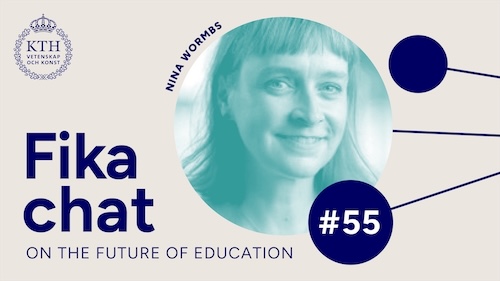
Fika Chat on the Future of Education episode 55 with Nina Wormbs. Graphic by Malin Ringsby.
Fika chat on Clear student information for AI and learning with Nina Wormbs
How should students know if and how they can use AI in a course? The Faculty Council has now produced a joint KTH recommendation on what teachers should tell students about what applies. Vice Dean
Nina Wormbs
reveals the "theft", why the recommendation is so short and talks (in Swedish) to Marcus and Joakim about the development, implementation and effects for teachers and students around AI and learning.
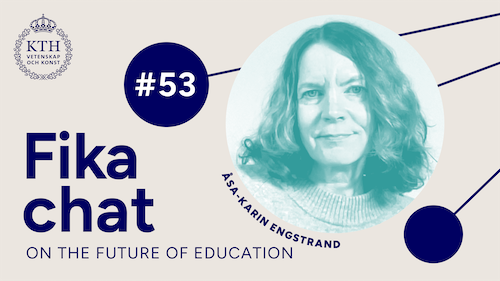
Fika Chat on the Future of Education episode 53 with Åsa-Karin Engstrand. Graphic by Malin Ringsby.
Fika chat on learning activities for ethical AI integration with Åsa-Karin Engstrand
How can ethical perspectives be taught to strengthen students' ability to handle ethical dilemmas related to AI? Marcus Lithander and Gunnar Tibert meet
Åsa-Karin Engstrand
who shares results from a development project on developing a model for ethical AI integration in the Industrial Engineering and Management programme.
Fika chat on Generative AI and programming with Henrik Kniberg
When today's knowledge in generative AI and programming will be dated asap, how will the role of teachers change? How will teachers learn to ensure that graduates have the ‘right’ skills that industry demands? Johan and Joakim Lilliesköld talk in Swedish to KTH alumnus
Henrik Kniberg (crisp.se)
about practical applications of generative AI and how it will change both education and the need for programmers in the future.
Fika chat on Various perspectives on AI in higher education with Arnold Pears and Avid Fayaz
How are generative AI tools used in courses today at KTH? Until KTH has decided on common guidelines: what general principle can students use to know what is considered ‘cheating’? What can't be said too often in these contexts? Johan and Joakim Lilliesköld talk to Professor
Arnold Pears
and student
Avid Fayaz
, who is a podcaster and active in the
KTH AI Society
.
Fika Chat on the KTH-joint AI project taking off autumn 2024 with Arnold Pears
What can we expect from the first KTH-wide AI project, due to start in autumn 2024 as part of the Future Education initiative? Johan Flid Fridell and Per Fagrell meet Arnold Pears, project manager for
Integration of AI in KTH’s courses and programmes offered
on how KTH can/should use AI in teaching.
Fika chat on how AI is changing education with Arnold Pears
Arnold Pears is Professor of Engineering education research at KTH. His research focuses on understanding the learning experience from a student perspective, both in terms of learning specific engineering concepts and more generally in terms of engineering skills and competences. He joined the latest episode of the podcast to talk about the impact of AI on education and teaching.
If you want to print the transcription file on KTH Play, you can find the transcription function by 1. clicking the icon at the top right of the video view (a text field appears to the left in the video view) and 2. Click on the three dot menu that appears.
If you are looking for more extensive information about a particular episode, they are also found on
All episodes
.
If you want to print the transcription file on KTH Play, you can find the transcription function by 1. clicking the icon at the top right of the video view (a text field appears to the left in the video view) and 2. Click on the three dot menu that appears.
If you are looking for more extensive information about a particular episode, they are also found on
All episodes
.
About the podcast
Marcus Lithander chats over coffee (fika) with guests from or outside KTH about the future of education in general and our change programme "
Future Education at KTH
" in particular.
Post questions live or email beforehand
Since we are podcasting live, you have the opportunity to ask questions and comment during the conversation. You can also email questions beforehand to
framtiden@kth.se
.
Co-create for the podcast
Do you have suggestions for podcast topics? Then you are welcome to contact
framtiden@kth.se
(write "podcast" in the subject line).