This page brings together AI-related activities, projects, resources, and podcast episodes within ‘Future Education’ to facilitate knowledge sharing and provide an overview. The AI projects are coordinated by cluster leader Olga Viberg (contact details can be found at the bottom of the page).
AI-projects within Future Education at KTH
Do we actively use AI in learning and teaching? Is AI seen as an engineering tool in applications?
The project number at the end of the line consists of the decision year and serial number (no ranking function).
Here we have compiled a range of research findings, presentations, webinars and reports to inspire your own professional development in the field of AI.
Research on AI in education
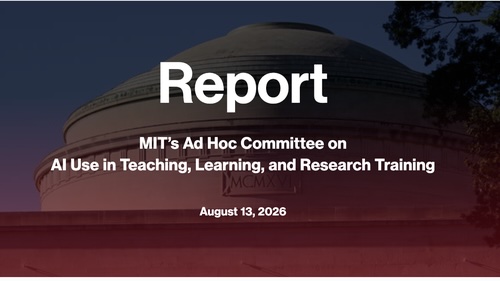
Report
AI Use in Teaching, Learning, and Research Training
The report highlights key aspects of MIT’s current educational situation, sets out eight guiding principles for the way forward and recommends immediate and long-term measures.
Eric Klopfer, Sam Madden, MIT Committee on AI Use in Teaching, Learning, and Research Training, August 2026
Artificial intelligence, cognitive offloading and implications for education
A report on how AI affects learning highlights the risk that AI may hinder deep learning and critical thinking, and sets out strategies for using AI in a way that enhances, rather than replaces, learning.
Jason M. Lodge, Leslie Loble, University of Technology Sydney (UTS), March 2026
Seminar
Digital Game-Based Learning from Childhood to Adulthood: Evidence, Insights, and Future Directions
Digital Futures invites you to a seminar with Prof. Bruce McLaren from Carnegie Mellon University on what research tells us about how adults relate to, benefit from and sometimes resist game-based approaches in higher education, workplace training and lifelong learning.
Assessment in the Age of AI: Teachers Adapt, Students React
Assistant Professor Richard Lee Davis presents results from studies by E-learning, involving 311 teachers and 1,291 students at KTH, providing an overall picture of AI use at KTH: how AI is used, the risks involved, and the opportunities that emerge when generative AI is adapted to assessment and teaching.
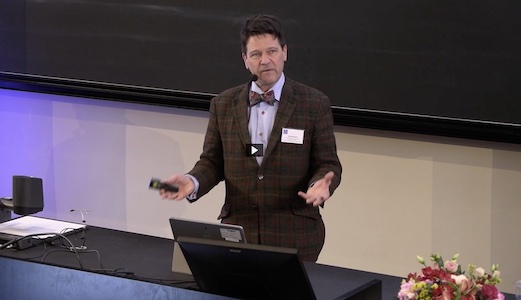
Engineering Education Education Futures: How will AI & ML transform higher education?
"He exaggerated a little," said an audience member after Professor Arnold Pear's end note at SoTL 2023. Arnold talked about, among other things, individualised learning experiences and how campus institutions must rethink their resources. Do you agree?
On behalf of the Government, the Swedish Higher Education Authority (UKÄ) has analysed the potential impact of artificial intelligence (AI) on higher education programmes in relation to future skills needs in the labour market.
KTH offers a wide range of free stand-alone courses in AI. Several of these courses are delivered online via distance learning, and we have courses for both beginners and those who wish to build on their existing knowledge.
A series of articles focusing on artificial intelligence and humans presents exciting research from KTH.
Theme AI and humans (kth.se)
Fika chat podcast episodes on AI and learning
Listen/watch to episodes of the podcast Fika Chat on the Future of Education focusing on AI and learning.
Podcast #78
Fika chat on digital game-based learning
What does the research say about digital game-based learning (DGBL)? How can AI-driven personalisation, feedback and assessment be integrated into the game to support learning? Joakim Lilliesköld and Marcus Lithander discuss with Professor Bruce M. McLaren and doctoral student Elias Hedling.
Just nu (mars månad) jobbar IT med att sätta upp det tekniska så KTH-grupper ska få tillgång till miljön. Därefter kommer de grupper inom KTH som vill använda Google Cloud-tjänsterna kunna göra det om det finns en projektkod som kan knytas till användargruppen så att alla kostnader kan faktureras direkt till gruppen.
Användaren behöver själv ansvara för att lära sig hur man ska använda Google Cloud-tjänsterna, då det i dagsläget inte finns budget för support eller stöd på KTH för detta.
Observera att information om Google-avtalet saknas i skrivande stund på IT:s sidor om
KTH’s approved AI services
.
How have generative AI tools changed the way students learn and what does it mean for KTH and teachers? Marcus Lithander and Joakim Lilliesköld discuss (in English) with Olga Viberg, appointed Future Education Cluster Coordinator for AI and Learning at KTH.
Fika Chat on recommendations for AI use in KTH’s teaching
How has the Faculty Council’s recommendation on what teachers should tell students about course-specific AI use been implemented at KTH? Marcus Lithander and Anna Jerbrant discuss in Swedish with Caroline Bern (E-learning) and Iris Callerholm (KTH Student Union, THS).
Fika Chat on clear student information for AI and learning
How should students know if and how they can use AI in a course? The Faculty Council has now produced a joint KTH recommendation on what teachers should tell students about what applies. Marcus Lithander and Joakim Lilliesköld meet Vice Dean
Nina Wormbs
on the development, implementation and effects for teachers and students around AI and learning.
Fika chat on learning activities for ethical AI integration
How can ethical perspectives be taught to strengthen students' ability to handle ethical dilemmas related to AI? Marcus Lithander and Gunnar Tibert meet Åsa-Karin Engstrand who shares the project results.
How can practical applications of generative AI look like and how will it change both education and the need for programmers in the future? Johan Flid Fridell and Joakim Lilliesköld talk in Swedish to KTH alumnus
Henrik Kniberg (crisp.se)
about
Generative AI in a Nutshell (Youtube)
Fika Chat on the first KTH-joint AI project taking off autumn 2024
What can we expect from the first KTH-wide AI project, due to start in autumn 2024 as part of the Future Education initiative? Johan Flid Fridell and Per Fagrell meet Arnold Pears, project manager for
Integration of AI in KTH’s courses and programmes offered
.
What impact will AI have on teachers’ teaching? Johan Flid Fridell and Joakim Lilliesköld meet Arnold Pears, Professor of Engineering Education at KTH, who researches the learning experience from a student’s perspective in relation to specific technical concepts, engineering skills and competences.