KTH's Sustainability Objectives and Measures for Efficient and Sustainable Resource Management 2026-2030.
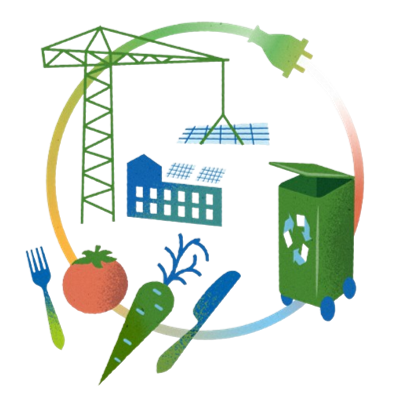
This objective covers: Climate, Purchasing and Procurement; Waste management; Buildings and Premises, including Energy; Travel; Food and Food Services; and Biodiversity.
Illustration by Jens Magnusson.
Sustainability objectives
KTH’s operations shall be characterised by efficient sustainable resource management that contributes to sustainable development.
By 2030, KTH shall have reduced its total climate impact by 60 per cent (Scope 1, 2 and 3) in order to achieve net-zero greenhouse gas emissions by 2045 at the latest.
KTH shall conduct long-term work to increase, protect and restore biodiversity and ecosystem services.
Measures
KTH shall set environmental and sustainability requirements in procurements, purchases and call-offs where relevant. These requirements shall be systematically monitored and continuously improved.
Products and services procured by KTH shall be resource-efficient, have a long service life and be recyclable when taken out of use.
KTH shall, in collaboration with other higher education institutions, take a proactive role in developing methods and working practices to ensure that environmental and sustainability requirements are set in a uniform and effective manner in procurement and purchasing.
KTH shall develop working practices for circular purchasing and for reducing waste, and establish campus-wide reuse systems in order to reach the two highest levels of the EU waste hierarchy.
KTH shall further develop working practices to a greater extent to reuse, repair and share goods and services within the university in order to reduce the total amount of waste.
KTH shall increase the rate of source separation by improving the infrastructure for sorting, in particular for food waste and packaging, and through initiatives for behavioural change.
KTH shall, in collaboration with property owners and other higher education institutions, develop common methods and working practices to ensure management and follow-up of the organisation’s waste handling.
KTH shall develop systematic energy management in accordance with relevant recommendations in order to reduce the university’s final energy use by two per cent per year compared to 2021.
KTH shall develop data-driven analyses (including AI) and technical platforms for efficient use of premises and reduced energy use and climate impact. Relevant key performance indicators and detailed measurement data shall be developed.
KTH shall set requirements in line with relevant certifications, aiming for the highest level, to reduce negative environmental and climate impacts from new construction and refurbishment projects.
KTH shall further develop a standardised process for premises projects that integrates measurable sustainability requirements in all phases – from needs analysis to management.
KTH’s laboratories shall be developed in accordance with relevant certification requirements for sustainable laboratories.
KTH shall ensure that emissions from air travel are reduced by eight per cent annually from 2019 until 2030. By 2030, KTH’s total climate impact from business travel shall have been reduced by 60 per cent (base year 2019).
KTH shall further develop system support for monitoring business travel in order to strengthen and automate the follow-up process.
KTH shall, in collaboration with other higher education institutions, develop common methods and working practices aimed at reducing emissions from business travel.
In procurement and purchasing, KTH shall choose food and catering services that reduce climate impact and promote biodiversity.
KTH shall, in collaboration with relevant internal and external actors, develop sustainability work related to food and food services on campus.
KTH shall set requirements for property owners to carry out long-term work to protect, restore and increase biodiversity and to integrate ecosystem services.
KTH shall collaborate with relevant actors to strengthen and develop the work of protecting, restoring and increasing biodiversity and ecosystem services on KTH’s campus areas.
Important documents, links and tips
Tools, guidelines, and shortcuts to support climate-smart choices, circular resource use, and reduced environmental impact in KTH’s operations.