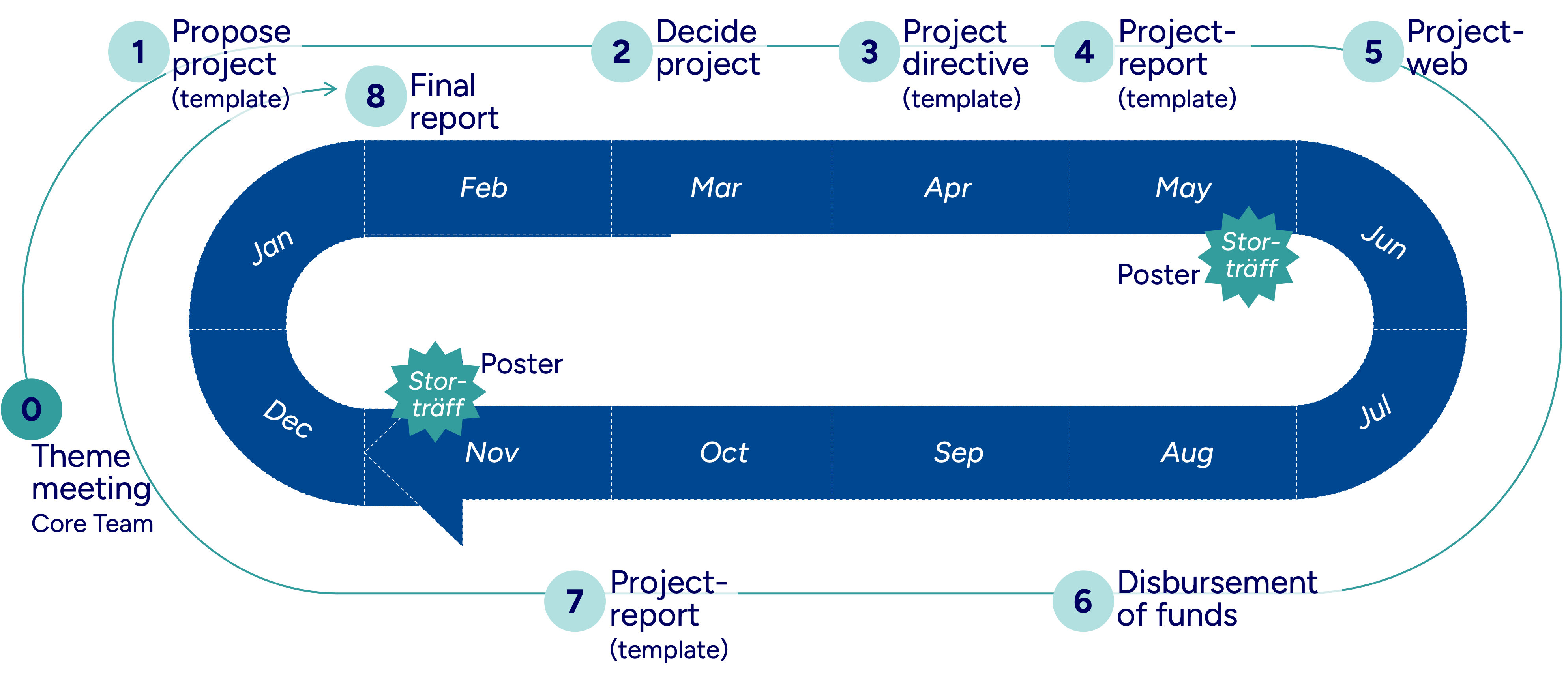
The Future Education programme is allocated funds each calendar year to initiate strategically important development initiatives. The programme management decides on the distribution of these funds based on an established process in which Future Education and the schools’ directors of first and second cycle education (GA and vGA) collaborate.
Projects that have been decided to be funded must first create a project directive and then report semi-annually according to the Future Education process (a simplified version is found in the year wheel above). Templates and deadlines are important so that the projects can be made visible at, for example, the Storträffen meetup.
The 2026 deadlines are shown in italic+bold text below. Links to the templates, lead to OneDrive, and are accessible to anyone with a KTH ID who is logged in.
Theme meeting with Core team
Before the end of the year, the program management holds a theme meeting with the Core team to firstly agree on the coming year's process and secondly to look at
strategic themes (Swedish)
. The Core team consists of all schools’ directors of first and second cycle education (GA) and deputy GA, as well as student representatives from THS.
Propose project
All employees at KTH can propose projects within educational development by filling in the
template for project proposals (Swedish)
. At the schools, the proposals are coordinated by the GA/vGA, as the schools and Future Education usually fund half of the projects each. In 2026, the proposal period ends on 16 February for submission of the schools’ proposals (note that each school may have internal deadlines previous to this date).
Decide project
The school projects which will be funded are decided by the program management in collaboration with the Core Team and are anchored with KTH’s management team. 2026 approx. week 10.
Project directive
All projects decided to receive funds for a certain year must fill out a project directive (
Pdir-template (Swedish)
). This applies to new projects as well as those continuing from the previous year who are receiving further funding this year. Note the difference: the project proposal (step 1 above) is the basis for decision-making for the projects, while the project directive (step 3 here) is the basis for disbursement. Tip: Copy the text from the project proposal and supplement/further develop it in the project directive. Normally, both project proposals and directive documents are kept together at the (v)GA level, precisely because no money can be disbursed to the school before all of the school's directive documents are received. Deadline for spring 2026 (VT26) is 13 April.
Project report and poster (spring)
All ongoing projects fill out a project report in A3 format (
template project report (Swedish)
) every six months. This semi-annual report should focus on produced results. Deadline spring 2026 is on 20 April. Based on the report, Future Education creates a poster for visibility at the semester’s Storträffen meetup. The project can also choose to create its own poster (
Poster template (Swedish)
).
Project web page
Future Education creates a project web page for each new project based on the information in the project directive and the report. For school projects, all new web pages are approved by the GA/vGA at the school.
Disbursement of funds
When all project documentation is received and the project has started, the funds are disbursed. This means that the schools may receive the funding at different times.
Project report and posters (autumn)
See 4 above. This semi-annual report should focus on produced results. The only difference is that in the spring the poster is created in English and in the autumn in Swedish. Deadline autumn 2026 is on 23 October.
Reporting (final report)
Development projects that have been completed submit a final report – for school projects – in the same A3 format (
template project report (Swedish)
) as before. The final report should focus on lessons learnt and how the project results can be scaled up / be useful for other organisational units at KTH. Deadline HT26 is 15 october. It's optional (for school projects) to also write a more comprehensive final report (in addition to the A3
Final report-template (Word, Swedish)
) if you find the A3 format too limiting and want to share your experiences on a deeper and/or broader level.