The 2025 project portfolio and kick-off for 2026 within Future Education at KTH
The 2025 project portfolio is listed below by theme, and two KTH-wide projects invite you to participate. The application process for new projects in 2026 begins on 15 January.
Tool for innovative drive
– Not all strategic educational development at KTH takes place within the Future Education programme. There are many many initiatives throughout the organisation; It's fantastic the innovative drive that exists at KTH, says Anna Jerbrant, programme manager, and continues:
– Future Education is the management's tool for strengthening this will to change and the drive for innovation by giving us dedicated time for the work through the funding that the Future Education programme can provide.
The Future Education programme also adopts a more strategic, holistic approach to our change initiatives. Partly to identify the direction of essential and strategically overarching issues that may not currently be owned by any designated unit, and partly to initiate KTH-wide projects that benefit KTH as a whole.
Call for project proposals for 2026
The programme also has an established process that can facilitate both joint project management (initiation, financing, follow-up, etc.) and the sharing of knowledge, which in itself is always a project outcome. The application process for new projects in 2026 begins on January 15 (see process ). The proposal period ends on 16 February for submission of the schools’ proposals (note that each school may have internal deadlines previous to this date).
The Maxistudio and Tablets projects invite you to participate
The schools initiate many projects within Future Education, while some projects are carried out at the KTH-wide level.
Two of the 2025 KTH-wide projects are the Maxistudio and Tablets. The Maxistudio is available to everyone at KTH, and the pilot phase begins in January 2026. Podcast episode 70 (available here) provides more information about the Maxistudio and also shows how to book and use the studio in practice. The Tablets project (e.g. for digital assessment outside the computer room) is also open for testing by more schools. More information is available on the project websites: Further development of the Maxistudio at KTHB (2502-KTH) and Tablets for flexible digital teaching and examination (2501-KTH) .
Thematic grouping of the 2025 portfolio
The 2025 project portfolio demonstrates both breadth and depth, and several clear themes can be identified through portfolio analysis. The themes are somewhat more flexible than grouping the projects by their main principles. The theme grouping thus complements the division of projects by principle .
Below is a list of all active projects in 2025 (just over forty), both new ones in 2025 and those from previous years that were still active, grouped by theme.
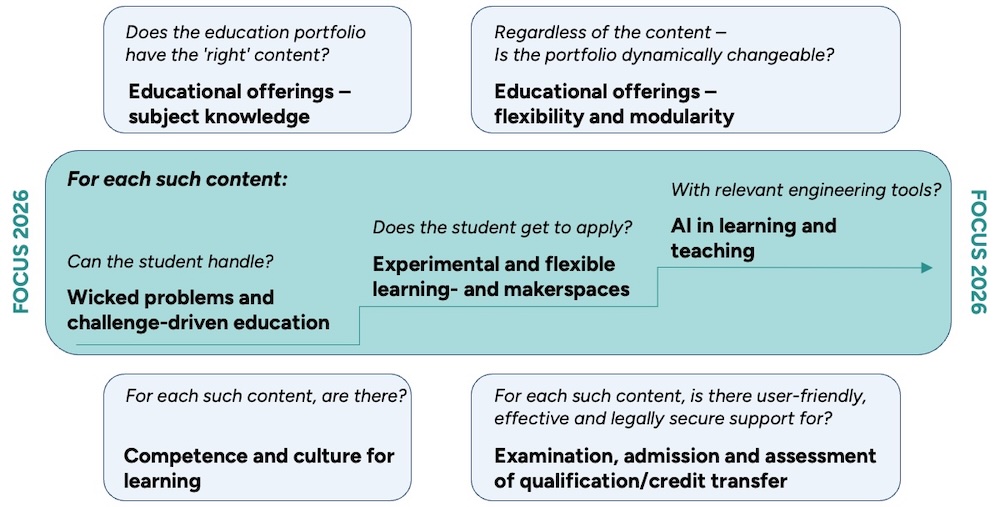
The main focus is on (see image above):
- Wicked problems and challenge-driven education
Do students have the ability to deal with wicked problems? For all components of the education portfolio, do we conduct challenge-driven education (CDE)? - Experimental and flexible learning- and makerspaces
Can students apply their knowledge and skills in flexible and experimental learning- and makerspaces? - AI in learning and teaching
Do we actively use AI in learning and teaching? Is AI seen as an engineering tool in applications?
In addition, there is:
- Examination, admission and assessment of qualifications/credit transfer
Do we have user-friendly, effective, and legally secure support for examinations, admissions, and assessment of qualifications/credit transfer? - Educational offerings – flexibility and modularity
Do we have an educational portfolio with modularised components that can be flexibly packaged and strategically valued? - Educational offerings – subject knowledge
Does the education portfolio have the 'right' components (subject knowledge) based on today's needs? - Competence and culture for learning
Do we have the relevant competence and culture for learning for all components of the education portfolio?
The project number at the end of the line consists of the decision year and serial number (no ranking function). The projects are listed in numerical order.
Wicked Problems and Challenge Driven Education (CDE)
- Wicked problems in a sustainable context within Built environment (2302-ABE)
- Progression of general skills and abilities within CING programmes (2323-SCI)
- Challenge-driven education with wicked problems for sustainable development and transformation (2402-KTH)
- Scalable module for Design Thinking (2513-ITM)
Experimental and flexible learning- and makerspaces
- PRIM – Prototyping, Industrialisation and Manufacturing Open Lab (2317-ITM)
- Further development of the Maxistudio at KTHB (2502-KTH)
- Creative teaching in engineering education: incentives, challenges and tools (2504-ABE)
- Nebula – sustainable use of IT infrastructure (2506-CBH)
- Detached energy labs for increased accessibility, flexibility and engagement (2519-ITM)
- Pedal Car Factory - a modern, digitalised and accessible learning environment (2520-ITM)
- Experimental learning activities and examinations in the field of physics (2521-SCI)
AI in learning and teaching
- Integration of AI in KTH’s courses and programmes offered (2401-KTH)
- Pure Question-Based Learning (pQBL) with AI-generated learning objectives and activities (2415-EECS)
- Interactive learning with automated feedback and continuous assessment (2416-EECS)
- Integration of AI into the ABE school's course offering (2503-ABE)
- AI & Management MOOC with campus track – AIM-X (2515-ITM)
- Implications of AI tools in education (2516-ITM)
- Assessment model for degree projects: AI-generated thesis or work process? (2517-ITM)
Examination, admission and assessment of qualification/credit transfer
- Digital and continuous assessment (2304-CBH)
- Teacher-centred examination support for a variety of examination forms (2405-KTH)
- DDMV2 – Data-driven assessment of qualifications of qualifications to Master's programmes (2406-KTH)
- Data-driven learning agreement and credit transfer – DDLA (2407-KTH)
- Tablets for flexible digital teaching and examination (2501-KTH)
- Improving on-campus digital examinations with Canvas/Möbius and AI (2518-ITM)
Educational offerings – flexibility and modularity
- Development of second-cycle programme structures and recruitment strategies (2307-CBH)
- Flexible recorded material for active learning (2320-SCI)
- E-mobility as a transversal Master’s profile (2403-KTH)
- Learning Centres - system demonstrator for broader participation and lifelong learning (2409-KTH)
- Safe study paths with clear specific entry requirements (2413-EECS)
- CDIO inventory and plan for KTH's Master of Science in Engineering programmes (2511-ITM)
- Indicators and incentives: course offering renewal at advanced level (2522-SCI)
Educational offerings – subject knowledge
- Learning material for creating free-body diagrams within technical mechanics (2321-SCI)
- New Master's programme: Molecular Biotechnology and Bioinformatics (2505-CBH)
- Human-computer interaction with free start and free pace (2508-EECS)
- Virtual curriculum for sustainable development in TINTE (2514-ITM)
- The government investment in mathematics – Maths 2025 (2524-SCI)
Competence and culture for learning
- The design studio's pedagogical landscape in built environment (2303-ABE)
- Increased student completion in chemical engineering programmes (2306-CBH)
- Mentoring programme for future engineers (2507-EECS)
- Stronger together! – teaching team for programming courses (2509-EECS)
- Course design, learning and quality development (2512-ITM)